The swamp stank of death.
Bhakris Edge lay motionless in the mire, his stone-gray skin slick with blood and rot as the last of the ghasts lunged for him. Pebblesong’s small form knelt beside him, her hands trembling but sure as she pressed the edges of a healer’s kit to his wounds. The air shimmered faintly with the scent of crushed herbs and bogwater. Somewhere above, Thalmiir’s axe rose and fell in a gleaming arc, and with a final, brutal swing, the last ghoul was cloven from neck to chest. It toppled silently, sinking into the muck as if the swamp were claiming one of its own.
A hush fell. For the briefest breath, all that could be heard was the slow drip of water and the distant groan of the dead.
“Go,” Thalmiir rumbled, voice thick with exhaustion. “They’re still coming.”
And indeed, behind them — faint, but certain — came the shuffle and drag of a thousand heavy feet. The horde.
Pebblesong’s breath hitched as Bhakris gasped, eyes fluttering open, pulled back from the edge of the afterlife by her touch. In that moment, he had seen paradise — halls of light and glory, warriors greeted by the gods — and had felt the shame of being turned away. When his eyes opened, it was not to glory but to mud and smoke and the unrelenting stench of decay.
They fled.
The moonlight caught their silhouettes as they stumbled through the quagmire — Hat’s small frame darting ahead, Bartholemeow’s feline form bounding in the muck, Waer’dara’s spider form gliding eerily silent as she bore Bhakris across her back, his limp body secured in webbing. Pebblesong whispered spells between gasping breaths, calling gusts of clean air to swirl around them as foul gases bubbled up from beneath the peat. Thalmiir pushed forward, half carrying, half dragging where needed, his thick legs churning the water. It was slow, grueling work, and every heartbeat carried the fear that the next breath might bring poison or death.
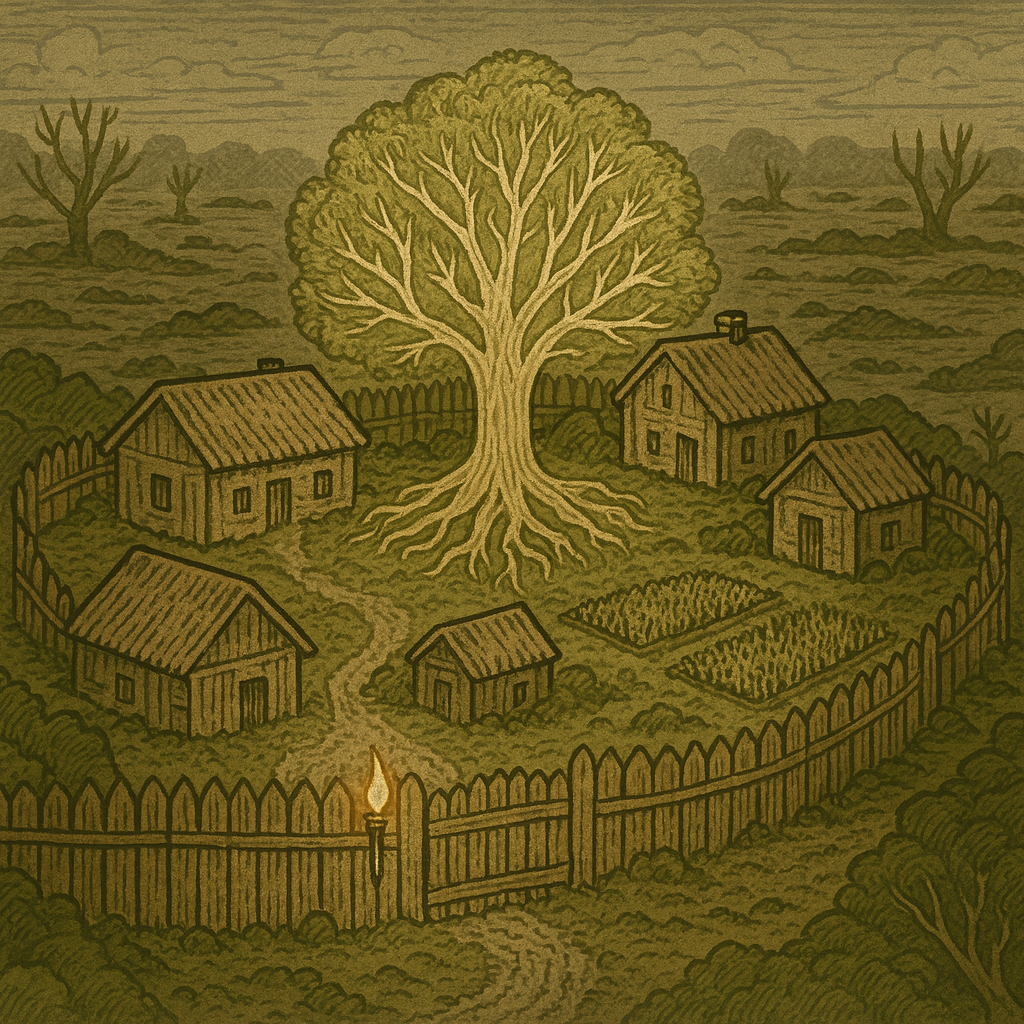
But Pebblesong’s magic held. Her tiny cyclones of fresh air whirled around their heads, cutting through the swamp’s miasma, giving just enough clarity to move forward. When at last their boots found solid earth, they crested a low rise, and beyond it — faint torchlight. The farm.
Relief washed through the group, though no one dared say it aloud. They had seen too much of hope betrayed.
As they neared the palisade, a shout rang out: “Halt! Identify yourselves!”
The gate guard’s voice was shaky, uncertain. Bartholemeow stepped forward, his whiskers glinting in the torchlight, and raised his pan flute with a tired grin. A trill of playful notes drifted through the night. A tune of life — defiant in a land of death.
The guard squinted, then laughed. “I’ve not heard the dead play like that before! You don’t look much better than corpses, but I’ll take it.”
The gates creaked open, and the weary adventurers stumbled through.
Inside, the smell of hay and bread — real bread, warm and alive — filled their lungs. It was a smell that nearly broke them. They collapsed inside the communal hall, half from exhaustion, half from relief. Waer’dara shed her monstrous form, silk dissolving to dust, and cleaned the grime from them all with a whispered spell. They emerged gleaming — ragged, torn, but clean, as though newly reborn from the swamp’s filth.
They slept.
Thalmiir took first watch, standing shoulder to shoulder with Jory, the farmhand who paced between gates like a man condemned. The night was quiet but not still. Far out in the fields, the faintest movements — slow, uncertain, the dead without direction. Thalmiir’s eyes narrowed, his hand tightening on his axe. “They’re stragglers,” Jory whispered. “We watch, we don’t wake the folk unless they come close.”
So he watched. And for the first time in days, nothing came.
Dawn broke thin and gray. Inside the hall, the others stirred, aching but alive. Old Gran, the Wheat Whisperer, arrived first — her sharp eyes missing nothing. She ushered them toward the bunkhouse with a firm hand and a gentle voice. “You’re no use to anyone half-dead. Rest.”
They did. And when the sun rose higher, they woke to the smell of butter and bread once more.
At lunch, the farmers gathered. Barold, stern-faced and broad, waited with questions. Bartholemeow sat upon a stool, strumming his lute, and began to sing.
He told of their journey — of the bog, the hag, the dead. Of the broken tower and the cursed circle of stones. Of Bhakris’s fall and Thalmiir’s wrath. Of Pebblesong’s small miracles and Waer’dara’s silent devotion. His words painted light across shadow, truth through fear. The tale wove around the hearth, and even Barold’s hard eyes softened.
When he finished, silence fell.
Old Gran spoke first. “The stones beneath Sorrow’s Rest… old magic. Our stories tell of such things. There was a ritual once, long forgotten — tied to our tree.”
At that, Pebblesong’s brow furrowed. She asked to see the tree — the one that had stood as long as memory. Outside, it shimmered pale and strong, its silver bark gleaming in the midday light. She knelt, whispering to the earth, feeling its pulse. It was alive — far older than it should be, and blessed by something deep and ancient. Her magic tingled against its unseen aura: neither holy nor foul, but balanced, as though life and death met in truce beneath its roots.
Inside, Bhakris questioned the old woman further, curious of the tree’s tale. Gran smiled wistfully. “It’s older than us all. Maybe older than this world. Some say the fey brought it, others say the gods planted it to remind us that all things grow from death. It’s a good tree.”
A good tree — but its heart hummed with secrets.
Talk turned to the bodies. To the cart. To the endless tide of undead. The realization came slowly: the corpses were being delivered to the swamp. Carted in from elsewhere. The dead were not of this place — they were fuel for something older, darker, and deliberate.
And yet, in all of this, hope remained — a thread of it, glinting like silver beneath the grime.
The hag had spoken of a ritual that could protect the land. A blade untouched by blood. The ashes of a hero. A tree that had seen too many seasons. Pebblesong’s eyes met Barold’s as he glanced toward the metal box upon his mantel. “The ashes,” he muttered. “We’ve got those, at least.”
“Then we can help,” she said.
And so they began to plan. Hat — ever the tinkerer — would forge the blade. Pebblesong would return to the hag. Thalmiir would stand watch. Bhakris, haunted still by the vision of Valhalla denied, would seek redemption through service. Bartholemeow would write their tale, to remind the living that light still sings against the dark. Waer’dara would bind their purpose together, her magic the silk that held their fragile hope intact.
Outside, the wind whispered through the birch leaves — westward, toward the river, toward whatever fate awaited them beyond the bog.
For now, they had survived. For now, the farm still stood.
But far to the north, in the swamp where the mist hung heavy, something stirred.
Opening context recap (DM Ben): Combat conclusion against the last pursuer: Stabilizing Bhakris and immediate retreat: Decision to flee and travel pace: Obstacle—patch of swamp gas (night travel): Assessing the fields near Baroldson’s Farm (pre-dawn): Approach to the palisade and gate exchange: Initial rest logistics inside Baroldson’s settlement: Night watch observations: Morning interactions—Old Gran and relocation for sleep: Midday meal and debrief setup: Bartholomeow’s prepared performance (the debrief “epic poem”): Bartholomeow delivered a prepared performance recounting the expedition; he received advantage due to preparation and Guidance from Pebblesong, resulting in a very high success (noted roll 22 on persuasion/performance). Content emphasis in the performance: Clarifying details and Q&A with Barold and Old Gran: On the broken tower and dreams: It could reach the party through nightmares; the Hag had intervened to draw them to her sanctuary. On zombie intent and Sereth’s role: On the source of bodies: The group had observed corpses on a cart used to supply materials for raising undead; the ultimate source remained unknown. Map to the tower: The party produced a map, found on corpses at an abandoned campsite, indicating the tower lies about six days into the swamp. Old Gran remarked that this distance explains why locals hadn’t seen it. Barold’s concern: He prioritized immediate defense and understanding the threat to the settlement; he was skeptical of going to Seacomer for help. Discussion about the central tree at Baroldson’s Farm: Old Gran described the tree as ancient, possibly touched by enchantment or fey origin; it is central to the settlement’s identity. She referenced tattered lore passed from grainspeaker to grainspeaker about a great ritual connected to their tree and to something in the bog; details are fragmentary and confused. Waer’dara stated that the Hag of the Bog blessed the tree. Pebblesong examined the tree outdoors: Protective ward plan via the Hag’s instructions: The party recalled the Hag’s protective rite requiring: Barold and Old Gran looked meaningfully at a metal box on the mantel, implying suitable ashes might be available. Discussion of the blade: Junior and the cart lead: Geography and possible next steps: Old Gran and others summarized the westward terrain: farming worsens away from the bog; further west are woods, then the Delimber River, and beyond that the High Forest. The party noted that moving west (away from the bog) might mean encountering fewer undead. Thalmiir suggested raising the matter at Seacomer, but Barold doubted it would help; nonetheless, the party considered that route. Priority discussion: Strong inclination to protect Baroldson’s Farm first by completing the Hag’s warding ritual (using the mantel ashes and a bloodless blade) to secure the wheat supply and safeguard the settlement. Thereafter, the party could pursue leads such as: Session endpoint:Session Notes