They arrived not quite late enough to offend, nor early enough to seem eager—precisely the sort of timing that suggested belonging.
Destiny’s headquarters loomed ahead, its elegant façade lit in soft evening glow, the greenhouse towers rising behind it like glassgrown cathedrals. A steady stream of well-dressed guests ascended the steps, their laughter and quiet conversation spilling into the night. Within that current, the party slipped seamlessly, clothed in borrowed refinement, their true intentions folded away like contraband in Barnaby’s concealed satchel.
At the door, propriety reigned. Invitations were presented, smiles exchanged, weapons surrendered with polite reluctance. Bhakris, stubborn in his armor, was quietly drawn aside, leaving the others to pass through gilded thresholds into a world of curated beauty and carefully managed illusion.
Inside, the air was perfumed with florals and sugar, the murmur of conversation underscored by gentle orchestral strains. Servants moved with uncanny grace, offering trays of delicate pastries—Moonflower creations among them—and drinks that shimmered faintly with magic. Everything gleamed. Everything smiled.
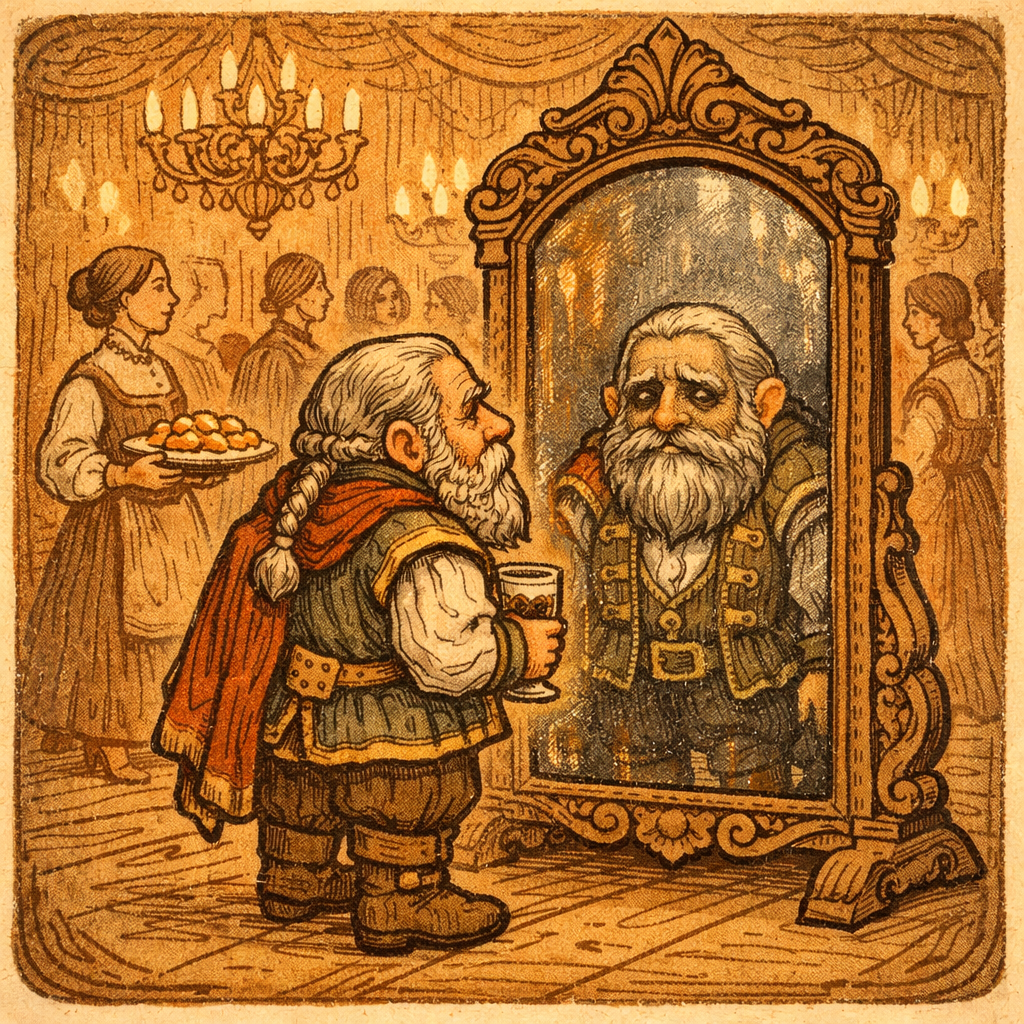
And then there were the mirrors.
They stood where none had been before—tall, ornate, impossible to ignore. Each reflection was flawless at first glance, but linger a moment too long, and the truth beneath the surface began to stir.
Thalmiir saw it first—or rather, he felt it. His reflection stood proud, dressed finely, yet behind the eyes lay ruin. Not merely failure, but failure made visible, etched into him like a brand. Generations of effort squandered. A name diminished. He could not look away from the certainty that everyone else could see it too.
Hat tilted their head at the glass and found something subtler, but no less cruel. The shape was right, the hat perfect—but the details betrayed them. Whiskers where none should be. A wrongness that whispered they would never belong, never be accepted as truly goblin. The mirror did not lie; it revealed.
Barnaby’s reflection stood apart even in a crowded room. Not physically—there were people all around—but the mirror showed distance, a quiet exclusion that followed him like a shadow. Others might speak to him, laugh with him, but at his core he was alone. And perhaps, the mirror suggested, that was as it should be.
Waer’dara saw not strength, nor the promise of ascension, but insufficiency. No grandeur, no terror worthy of her lineage—only a fragile, underwhelming figure clad in finery that would not save her when it mattered. Her grandmother’s imagined scorn weighed heavier than any armor she had chosen not to wear.
Only Bartholomeow emerged unscathed. The mirror returned exactly what he expected: charm, poise, a jaunty confidence slung across his shoulder like his instrument. Yet even he noticed the others—how they lingered, how something in them had shifted.
“Come,” he urged lightly, as if the moment could be brushed aside. “We’re at a party.”
And so they drank.
The offerings were whimsical—cosmetic transformations disguised as indulgence. A streak of color through Bartholomeow’s fur, a dark, goblinish mole for Hat, golden eyes for Barnaby. Harmless, temporary. Distractions.
For some, drink was the greater refuge. Thalmiir found himself drawn to the strongest ale available, seeking to drown what the mirror had made visible. Waer’dara joined him, less consumed but no less aware. The bitterness lingered.
Elsewhere, the currents of the party revealed their own secrets. Barnaby, towering and conspicuous, found himself drawn into conversation with a perfumed merchant whose confidence bordered on suffocation. A single, thunderous sneeze from Barnaby’s trunk disrupted the exchange, scattering both words and dignity—and granting him, at last, a measure of space.
Hat moved through the crowd with quieter intentions. A performance of delicate carving drew a curious onlooker close, attention fixed just long enough for nimble fingers to attempt their work. But the target proved alert; the attempt was caught, deflected. No alarm was raised, only a look—knowing, guarded. A lesson learned: not all prey in this garden was soft.
Meanwhile, Bartholomeow climbed the social lattice with practiced ease. He gathered voices like a collector of rare instruments—Sheila’s first, then another far more intriguing.
Count Vaelis Nocthero.
The man stood apart even among the elite, his movements smooth as silk, his presence drawing attention without effort. Their conversation was light at first—art, society—but beneath it ran a sharper current. At the mention of the Blackroot Bog, something shifted. The Count’s interest cooled, his words careful, probing.
Bartholomeow played the part expertly, implying knowledge he did not fully possess. It was enough. The Count revealed just enough in return—concern not of alliance, but of information. He sought to know what they knew, not to share.
A thread worth pulling.
Upstairs, a closed door marked Destiny’s private office. Nearby, a janitor’s closet offered no immediate secrets, though its presence suggested possibilities. The layout matched their expectations. The stage was set.
Then came the summons.
A bell rang, clear and delicate, and the crowd flowed into the central greenhouse. Glass walls rose high above them, enclosing a verdant cathedral where all eyes turned upward as Destiny herself emerged.
She was everything the room promised—radiant, poised, impossibly perfect. Her voice carried warmth, confidence, belonging. She spoke of beauty, of transformation, of products that revealed the best within. The crowd responded in kind, echoing her words, caught in the rhythm of her charisma.
And then, almost playfully, she spoke of something more.
A new product. Not yet ready. A promise whispered out of turn.
Olvidare.
A way to set aside burdens. To forget, if only briefly, the weight of memory. The mirrors suddenly seemed less whimsical.
The applause came, as it always did.
When she descended to mingle, the room shifted once more—attention drawn, paths converging subtly toward her. Bartholomeow slipped into position, sowing minor discord among those closest, creating just enough space to listen, to capture her voice for later use.
She spoke to each guest as though they mattered, as though she knew them. And when she came to Thalmiir, she spoke not of success, but of perseverance.
Of failure endured.
Of strength in continuing.
To any other ear, it might have been admiration. To Thalmiir, it was something sharper—yet her presence softened even that, wrapping it in sincerity he could not quite reject. He answered as best he could, grasping for meaning, for dignity. She shaped his words into something polished, something worthy, and moved on.
And in that moment—subtle, precise—Hat struck.
The hair clip found its mark, nestled unseen where it could serve its purpose. Destiny did not falter. She did not notice. The mask remained intact.
The party continued, bright and flawless.
But beneath the laughter, beneath the music and the glittering illusions, something had been revealed.
The mirrors did not lie.
And neither, perhaps, did Destiny.
The party prepares to infiltrate Destiny’s party by presenting themselves as appropriate guests rather than as burglars. Their plan is for Barnaby the Prodigious, Emeritus to conceal the group’s battle gear inside the bag of holding sewn into his cloak, gain entry to the event, and later use rope trick to hide the party in an extradimensional space until it is time to move around the building after the party has ended. They already know from prior intelligence that the guards do not seem to fully settle down for the night in the way the group had hoped. Before leaving, the group confirms the magical gadgets provided by their pixie allies, Pandora and Ulbricht. These items are the stalker hair clip, the silent ring, and the voice-changing fan. The party discusses who should carry each item, with some consideration given to who has the best skills for deception, perception, stealth, or sleight of hand, and whether any of the items require attunement. Bartholomeow claims the voice-changing fan because he has the strongest deceptive abilities in the group and can make especially good use of it socially. Hat takes the stalker hair clip, which will be useful for secretly tagging someone to track them. Thalmiir ends up carrying the silent ring, since he is not a spellcaster and is a reasonable choice to wield an item that creates a silence effect. The group also notes that the silent ring is not as overwhelming as first feared; it can be thrown up to a distance, but it only produces the normal silence spell effect rather than blanketing the entire building. Bartholomeow gives the party an Inspiring Leader speech before they depart, standing up and proudly talking about how well everyone is going to present themselves and about the Moonflower Café franchise opportunities tied to their current business arrangement. He frames the coming theft in jokingly polished language as “definitely, totally legal procurement of someone else’s stolen property.” The speech grants everyone eight temporary hit points. The party discusses the etiquette of arriving at a fashionable social event. Because Bartholomeow has some familiarity with the local society, he asks what the correct timing is. The answer is that arriving before the official start would be gauche, while fashionable guests tend to show up fifteen to thirty minutes after the start. The party settles on arriving roughly twenty minutes after the appointed time so that they will blend in with the main body of attendees. The group approaches Destiny Headquarters in the early evening. The building is a large, ornate two-floor structure with decorative windows and planter boxes, and from the front the main sign of its larger operations is the greenhouse visible behind it. Many finely dressed guests are converging on the same destination, making it clear that the party is well-attended and socially significant. The clothes provided by Pandora and Ulbricht successfully help the adventurers blend in with the fashionable crowd. At the entrance, the party encounters a line of guests and a polite but visible security process. Destiny staffers in golden blazers are checking invitations, while masked security personnel in golden armor stand nearby as a more symbolic display of force than an actively intrusive security presence. Guests are not being patted down, but visible weapons are being taken aside and removed. The party notices another guest surrender a fancy rapier to staff. Bhakris Edge, who had apparently intended to attend in full armor and armed as a paladin, is asked to step aside so that his attire can be discussed further with the staff. The rest of the party is invited to continue inside without him rather than hold up the line. They accept the invitation and proceed, leaving Bhakris temporarily separated at the entrance. Hat confirms that he is carrying tools on his person rather than storing them in the concealed bag. The discussion narrows this down to compact tools such as thieves’ tools or tinkers’ tools, and because there is no pat-down and the tools are pocket-sized, the staff do not intervene. Bartholomeow also brings a plausible travel-sized musical instrument as his spellcasting focus. Staff maintain perfect social composure and do not openly judge the oddities of what the guests bring in. Once inside, the group is welcomed warmly by a Destiny staffer with a manner so effusively gracious that it feels unnatural. The staffer uses a repeated phrase that frames the guests as “dearest friends” welcomed “from Destiny’s family to you,” accompanied by a strange little gesture. The mood is refined and socially polished, but the hospitality feels forced and slightly unsettling. The lobby is pleasantly crowded. Staff circulate with drinks and trays of refreshment, including the party’s own petit fours among the offerings. There are tasteful floral arrangements, banquet tables along the walls, and a front desk area usually used for store operations. One major change from the party’s previous visits is the installation of several large, ornate mirrors around the lobby. As soon as the party notices the mirrors, each member is forced to make a Wisdom saving throw against their influence. The effect is not framed as an obvious magical assault in-character, but it causes several characters to confront sharply magnified personal insecurities when they look at themselves. Thalmiir fails the saving throw. When he looks into the mirror, he sees more than just his well-dressed reflection. He perceives an aura of business failure hanging over him. The success and polish of Destiny’s operation reflect back at him as proof of his own failure and the ruin of his family’s business. What hits hardest is the sense that this catastrophe is somehow visible on his person, that anyone who looks at him can perceive his shame and squandered legacy. Bartholomeow succeeds on the saving throw. When he checks his reflection, he simply looks excellent: sharp, stylish, and entirely as he intended. His clothing and pose are flattering, and his instrument hangs at a perfectly jaunty angle. He does not suffer the same emotional disturbance and quickly notices that many of his companions appear shaken by the mirrors. Hat fails the saving throw. In the mirror, Hat’s outfit and signature hat still look stylish, but the reflection draws relentless attention to the details that make Hat seem insufficiently goblin. The whiskers stand out as especially alienating, and the mirror hammers home the fear that Hat would never truly be recognized as a “real” goblin by any goblin tribe, even if Hat ever managed to find one. Barnaby fails the saving throw. Looking into the mirror, he sees his robe successfully concealing the bag of holding, but he also becomes acutely aware that people seem to avoid him. The mirror presents him as someone encircled by a halo of solitude, someone who looks alone and perhaps deserving of being alone. The image reinforces Barnaby’s grim self-belief that people who trust him are making a mistake. Waer’dara fails the saving throw. The mirror does not merely reflect her appearance; it confronts her with the distance between who she is and the towering, fearsome drow legacy she feels she ought to embody. Rather than a commanding battle mistress or warlock approaching godhood, she sees someone small, inadequate, and unsuited to her ancestry. Even her spiders seem to undercut the grandeur she imagines for herself. Her dress looks good, but the mirror reframes that as weakness too: no armor, no protection, no strength. After the mirror effect, Bartholomeow notices that the others are visibly unsettled and tries to lighten the mood by suggesting drinks and reminding them they are at a fancy party. The party examines the refreshments more closely and finds note cards on some trays explaining that certain homemade pastries and drinks temporarily alter appearance for one day. Examples include coffee that changes eye color, hot chocolate that lengthens hair, fruit juice that puts a colored streak in the hair, white chocolate and raspberry cookies that lengthen eyelashes, pear crumble that adds fashionable freckles, and lemon lavender shortbread that produces a stylish mole on the cheek. The effect is explicitly cosmetic and temporary, and some guests already seem to be wearing these transformations. Bartholomeow studies the other guests to see whether the mirrors are unsettling everyone else in the same way. After making a strong read of the room, he concludes that some people do linger at the mirrors longer than expected, but nothing clearly distinguishes them from merely vain or fashionable guests. He does not detect obvious widespread distress. The adventurers choose whether to partake in the appearance-altering refreshments. Hat, still bothered by the mirror’s suggestion that he is not goblin enough, chooses an option that gives him a mole. The result is large, dark, and hairy, which makes Hat feel somewhat more goblin-like. Barnaby drinks the eye-color-changing coffee. He chooses for the transformation to turn his eyes a striking gold, which is especially noticeable when he glances at himself again. Bartholomeow drinks one of the fruit juices that puts a color streak in the hair. On his orange-tabby presentation, this manifests as a dramatic streak running through his fur with a lightning-bolt-like jag. Thalmiir ignores the vanity-focused magical refreshments and instead asks for strong drink, wanting to drown out the thoughts stirred up by the mirror. He receives a large, elegant tankard of barley wine and begins drinking heavily. Waer’dara likewise declines the appearance-altering offerings and instead also chooses the barley wine approach. The party notices a little schedule card indicating that Destiny herself will address the guests in about an hour, after which attendees are expected to gather in the central greenhouse. In the meantime, guests are free to mingle throughout the accessible public areas. The visible spaces include the lobby, the shop, the central greenhouse, the staff break room door where staff emerge with new trays, and the vestibule for the elevator. With about twenty minutes before Destiny’s address, the party spreads out according to their interests. Thalmiir continues drinking irresponsibly in response to the emotional hit from the mirror, though he believes he can handle it. Waer’dara remains near the café and bar area. Bartholomeow moves to mingle and gather information. Barnaby, by virtue of his conspicuous size and unfamiliarity, begins attracting attention from other guests. Hat looks for opportunities to steal from wealthy attendees. Bartholomeow first tries to identify whether any of the serving staff seems to be in authority or managerial control. He speaks with Sheila, the friend who works at Destiny’s operation, but beyond her he finds no obvious supervisory figure among the visible staff. If there is someone directing operations, that person is not on the floor. The staff present appear entirely focused on serving guests. Bartholomeow also decides to roam into other public areas, including the upstairs lounge, to see who is present and what can be learned there. Barnaby engages in casual small talk rather than deep social probing. A halfling man introduces himself and, before Barnaby can say much, eagerly launches into conversation. The halfling assumes Barnaby must be important because he is so distinctive and unknown, and he asks whether Barnaby is new in town and whether he represents a significant business interest or new venture. The halfling explains that he watches shipping from Waterdeep closely and boasts about making a pretty penny from it. He is heavily perfumed, and the cologne becomes overpowering to Barnaby’s sensitive nose. Barnaby answers vaguely and awkwardly. Eventually the smell provokes a massive involuntary loxodon sneeze: a loud trunk-blast of moist air that likely physically buffets the halfling without covering him in mucus. The halfling is visibly startled but awkwardly laughs it off and suggests Barnaby might go speak to someone who can help if he is unwell. After this, people begin giving Barnaby more physical space. Meanwhile, Hat looks for pickpocketing targets among the rich partygoers. The environment is full of tempting marks, though Hat notices that masked guards patrol the rooms in an unobtrusive way. It becomes clear that attempting a theft in a guard’s immediate presence would be risky, but there are gaps in the patrol pattern. Hat devises a social-distraction theft attempt. He performs a little show by carving one of the petit fours into the likeness of one of the patrolling guards, drawing some attention with the display. The carving is skillfully done and impresses onlookers, though the gathering it attracts is limited because the guests are trying to act too sophisticated for open delight. Only one person is sufficiently drawn in. Hat then attempts the actual pickpocket, using the distraction to close in. The theft fails when the intended target notices the hand moving toward their pocket and intercepts it. The attempt does not erupt into a public scandal or brawl, but the target clearly understands what Hat was trying to do and gives Hat a look. Hat recovers by cheerfully offering over the carved petit four and disengaging. Although Hat gains no loot, the failure reveals that the guards are not omnipresent and that there are real holes in the security coverage. Upstairs, Bartholomeow gathers information on the party’s guests. He spots the sheriff’s deputy whom Bhakris had previously approached, confirming that this local authority figure is present. He also identifies various fashionable and influential attendees: people connected to charitable trusts, the hostess of a fashionable salon, patrons of the arts, aristocratic types whose exact roles are less openly discussed, and a drow diplomatic envoy from an Underdark city. Among these guests, one particular figure stands out: Count Vaelis Nocthero. He is human and somewhat taller than average, but what truly distinguishes him is an otherworldly grace that makes him hard to ignore. Bartholomeow learns that he is a collector of rare art and wines and that he is not seen constantly around town but often enough to be recognized. Bartholomeow uses the voice-changing fan strategically. He had already captured Sheila’s voice as one of the fan’s stored voices, and he now gets close enough to Count Vaelis Nocthero to capture his voice as a second stored voice. He begins a polite social conversation with the Count. During their exchange, Bartholomeow probes for the Count’s relationship to Destiny. Vaelis becomes subtly frosty when Destiny is mentioned. He is not openly rude, but unlike many other guests he is not effusive about Destiny or her products. As the subject develops, the other people in the conversation drift away, leaving the two of them more privately positioned though not completely alone. Vaelis then changes demeanor and asks a probing question. He tells Bartholomeow that he and his friends carry “an echo of his mark” and asks whether they have been to Blackroot Bog recently, and whether they are “a friend of the bog.” Bartholomeow reads the situation well and realizes the Count is not looking for an ally so much as he is trying to determine how much the party already knows. Vaelis wants information without being the one to reveal too much first. Bartholomeow responds by carefully bluffing. He implies that the party does indeed know what happened in Blackroot Bog, trying to encourage Vaelis to reveal more while not actually admitting ignorance. The deception works well enough that Bartholomeow picks up an important implication: the Count seems specifically concerned with whether the party knows who was in charge of Sereth Hollow Voice, a matter the party itself had not fully resolved. The conversation is cut short when another person joins them and the subject shifts. Vaelis is clearly unwilling to continue speaking openly about Blackroot Bog or Sereth Hollow Voice in front of others. Bartholomeow gracefully steers the exchange back into socially acceptable territory and suggests they should have a more intimate conversation in the future. Vaelis agrees in a polished way that implies future contact is possible. While upstairs in the lounge, Bartholomeow observes that the atmosphere differs from the lower floor. The upstairs space is quieter, more seated, and more subdued. Conversations are calmer, with guests occupying chairs and sofas. He also notices a closed door marked as Destiny’s office. Bartholomeow makes a discreet attempt to investigate whether the janitor closet near the upstairs area might contain a hidden way into the elevator or some back access route. He casually slips down the hall and opens the closet door. Inside is simply a dark, cramped janitor’s space with normal support supplies. A quick glance does not reveal any obvious secret passage or connection. He realizes that properly searching it would require actually stepping inside and spending suspiciously long there, so he abandons the idea for now. Before Destiny’s scheduled address, Bartholomeow returns downstairs and rejoins the rest of the group, who are still generally clustered around the café and bar area. A staff member rings a small silver bell and announces that treasured guests should gather in the central greenhouse because Destiny will address them soon. Guests begin drifting that way, some collecting last-minute drinks or canapés. The party follows with the crowd. In the central greenhouse, the guests assemble facing south toward the main building. Above them is an enclosed second-floor balcony that effectively serves as a stage overlooking the greenhouse. The bell-ringing staff gather there as well and sharply ring their bells, bringing the room fairly quickly to silence. Destiny then appears on the balcony. She is described as tall and elegantly presented, seemingly a young woman, with flawless skin, fashionable makeup, and beautifully coiffed ringlets cascading around her shoulders and down her back. Her smile is immense and radiantly confident, capable of seeming to encompass the entire room. Destiny opens with a highly polished address welcoming the assembled guests as cherished friends and members of the Destiny family. She frames the event as a celebration of the company’s newest gift to its beloved supporters, another entry in its line of natural wellness and lifestyle products intended to let their “inner beauty shine for all the world to see.” When she says that phrase, the gathered staff echo it in unison. She then introduces the new line of products under the name “Earth’s Blessing.” The room applauds even for the name itself. Destiny explains that the line takes their offerings to a new level of transformative well-being, that the ingredients are carefully sourced and natural, and that product development is cruelty-free. At the mention of cruelty-free production, someone in the back boos. Destiny lightly hushes the dissenter and jokes about knowing how that person feels about cruelty, then smoothly re-centers the room by inviting the others to affirm that everyone else is against cruelty. The moment passes with polite applause. Destiny continues, promising that Earth’s Blessing will join the company’s suite of personalized consultations and offerings, always in service of bringing out the utmost inner beauty of their cherished guests. She then goes briefly off script to tease a future product line not yet ready for release. Despite claiming that her scientific staff dislikes when she does this, she announces “Olvidare,” a product meant to temporarily set aside recent burdensome memories in order to give users confidence, well-being, and unburdened joy. She emphasizes that the suppression is temporary and frames it as a brief respite from inconvenient memories and emotional hang-ups. She boldly promises the product in no fewer than two quarters, even while acknowledging that her staff may not appreciate her making such promises publicly. Thalmiir, already drinking and resentful, reacts to this announcement with dark amusement, privately imagining that the party is going to take away the key ingredient and ruin the plan. Destiny accepts the applause that follows and withdraws from the balcony. Fresh drinks and refreshments circulate, and the event shifts back into mingling, now with a stir running through the room because Destiny herself is about to move among the guests. As Destiny enters the mingling crowd, guests subtly angle to get near her. It is not an undignified crush, but it is obvious that many attendees want a moment of personal contact. Bartholomeow’s immediate goal is not to speak to Destiny directly but to get close enough to capture her voice in the voice-changing fan as its third stored voice. To accomplish this, he socially maneuvers through the crowd rather than waiting passively. He uses the fan very subtly to sow tiny bits of discord among the guests jockeying for access to Destiny. Using the captured voices of Count Vaelis and Sheila, he makes it seem as if one guest has made a petty comment about another and as if other half-heard remarks are circulating. He keeps the effect faint enough to avoid anyone noticing a talking fan, but the little pricks of social friction are enough to create small openings in the crowd. Thanks to this manipulation, Bartholomeow gets close enough to overhear Destiny and let the fan absorb her voice. While doing so, he also observes her social talent. She knows how to say the right thing to different people, making them feel specially seen, and she moves efficiently between interactions without getting trapped in any one conversation. She is clearly practiced and very good at this. After Bartholomeow has secured Destiny’s voice, Destiny herself approaches one of the party members: Thalmiir. She has apparently noticed him and maneuvers through the room until that brilliant, polished smile is directed straight at him. Destiny greets Thalmiir by name and claims to be excited and inspired by the stories of perseverance she has heard about him. She says she is in awe of the courage and inner strength it must take to continue on in business after setbacks, and she presents him as someone who has persisted where others would have given up. The wording, in another mouth, would sound cutting or insulting, but from Destiny it comes across as so graceful and radiant that it could plausibly be sincere admiration. Thalmiir, however, is too drunk and too emotionally raw from the mirror experience to read her clearly. He perceives the exchange primarily as a personal thing, and his first reaction is stunned surprise that she has heard of him at all. Destiny says that she tries to know all of her business partners and suppliers, even the people behind the petit fours, and compliments the pastries. She then asks what keeps Thalmiir going and how he continues despite setbacks. Seizing the opportunity, Thalmiir attempts to answer with business philosophy. He starts on a grand but muddled metaphor comparing business to a battlefield and talking about tactics and logistics. He clearly feels true passion and is trying to rise into an inspiring speech, but the actual content becomes incoherent under scrutiny. Destiny deftly rescues the conversation without making it feel like she is talking over him. After only a few sentences, she smoothly condenses what he is fumbling toward into a succinct, flattering conclusion and calls it inspiring. She says she cannot ignore her other guests, but that she will carry his words with her for the rest of her days, and then she moves on. After she leaves, Thalmiir mutters that what Destiny said was what he had been about to say, indicating that he experienced the exchange as both intoxicating and faintly frustrating. Bartholomeow, who has likely observed enough of this interaction to understand what happened, comes over and asks how Destiny could possibly know so much about Thalmiir’s business. Thalmiir, still caught up in the attention, simply calls her a very smart lady. Thalmiir’s conversation with Destiny also serves a tactical purpose. While her attention is occupied with him, Hat makes the move the party has been waiting for and attempts to plant the stalker hair clip on Destiny. Hat uses the distraction to get close and makes the sleight-of-hand attempt against Destiny’s not-inconsiderable awareness. Despite the difficulty, Hat succeeds. The stalker hair clip is attached to Destiny without her noticing. During the planting, Hat gets close enough to note one more detail: Destiny smells exceptionally good. With the stalker hair clip successfully placed, the infiltration phase of the evening is complete. The party has entered the party in disguise, identified significant magical and social features of the venue, learned about the mirrors and Destiny’s products, met Count Vaelis Nocthero and gleaned his connection to Blackroot Bog and Sereth Hollow Voice, captured the voices of Sheila, Vaelis, and Destiny for the fan, and secretly tagged Destiny for future tracking. The session ends there, with the party still inside Destiny’s event and poised to take advantage of what they have learned in the next session.Session Notes