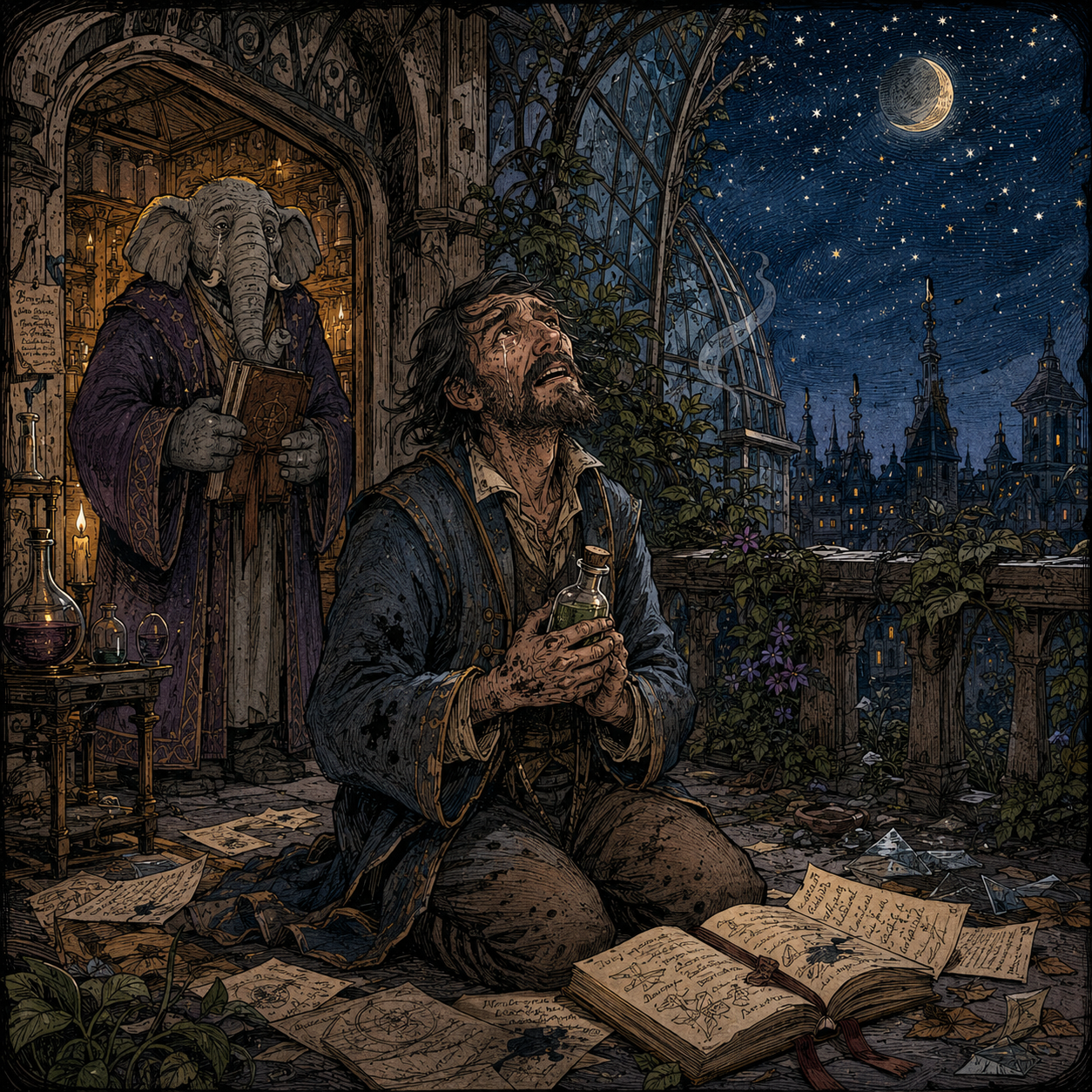
The lower chambers of Destiny’s house breathed like something wounded and angry. Firelight guttered across broken furnishings and blackened walls, staining the smoke with a feverish orange glow, while the darker hall beyond the doorway swallowed every spark that tried to enter it. Somewhere in that darkness, Destiny still lived. Burned and bleeding and cornered, she had nevertheless left terror behind her like a perfume, and the fear she had cast over the company still clung to their hearts in cold hooks.
Waer’dara, trapped in the elevator in the form of a spider, clung to Thalmiir with all the grim dignity an enormous spider could muster. Terror made strange companions of them. Her many limbs wrapped around the dwarf in a desperate, chittering embrace while the elevator carried them away from the battle, indifferent to panic, injury, or unfinished business. Thalmiir, who had faced blood and steel with fewer tremors in his bones, could do little but endure the hug and the awful upward crawl of the machine.
Bartholomeow, also caught in the rising elevator, recovered himself sooner. The icy compulsion loosened from his mind, leaving only the flutter of his own heart and the ridiculous music of the lift. So he did the only sensible thing a bard could do while being carried away from danger in a little box with a spider and a dwarf: he took up his lute and accompanied the tune. The song did nothing to slow the elevator, but it gave the fear a shape small enough to laugh at.
Below, Hat and Barnaby remained near the ruined chamber, with Bhakris lost somewhere beyond the inner door. Destiny had retreated into the dark hall, where the strange living room waited, its tendrils dormant for the moment. Hat’s cannon rolled into place, bright and absurd in the gloom, and spat force into the shadows. The blast struck something unseen, and Destiny vanished deeper into the black.
Hat considered the problem with the practical cruelty of a mind that had already found fire to be a useful solution. If he could not see Destiny, perhaps he could at least give the darkness something to think about. He sent a firebolt through the doorway, not so much aiming for flesh as for the haunted threshold itself. The bolt vanished into the room beyond.
The room answered.
From within came the wet, heavy thumping of tendrils striking walls, floor, and whatever else had the misfortune to be inside. It was a sound Barnaby knew too well now, the same brutal whomping that had battered him before. Then came an anguished cry from Destiny. The cry was short, ragged, and deeply satisfying.
Barnaby, trunk lifted, listened for another scream. None came. The darkness held its secrets.
He moved to the doorway and cast light upon a single ball bearing, the tiny sphere glowing like a captive star. With care, he dropped it into the hall. It bounced once, twice, then vanished from sight. Almost immediately the room awoke again, thrashing at the intrusion. The little light could not be seen, but its path could be heard in the pinging ricochet of metal and the renewed fury of the living walls.
Still no scream.
“Either she is dead,” the silence seemed to say, “or she is learning.”
Hat was less inclined toward patience. His cannon rolled closer, and he loosed a gout of flame into the hall. Fire roared into the darkness. Something inside wailed, an unearthly squawk of pain and rage, but still nothing emerged.
Then Destiny changed the shape of the battle.
She appeared not from the doorway, not from the killing hall, but behind Hat. One moment there was only smoke and confusion; the next she stood there, burned and wild-eyed, her ruined gown clinging to scorched flesh, her voice twisting into the words of a curse. The fear she had woven over the others broke as her concentration turned to this new malice.
But Hat did not bend.
The curse slid off him like rain from oiled cloth. Destiny howled, not in triumph but in frustration, as the magic failed to take hold.
“We can make a deal!” she cried. Her voice was cracked with pain, but desperation sharpened it. “We don’t have to do this!”
“You just tried to curse me,” Hat said.
“Because you keep trying to set me on fire!”
She looked at him then with sudden, terrible insight, as though she had found a hook buried deep enough to matter. “You, especially. You would be suited for this sort of thing. I know how to get you home. I can take you to your people. They’re in the Feywild. Your true family. They’re looking for you.”
For a breath, the flames in Hat’s mind hesitated.
Barnaby saw it. Destiny’s words were too well-chosen, too quick to find the tender place. She had built an empire on bargains that became cages, on gifts that became debts, on truths twisted into leashes. Even dying, she reached for one more chain.
“She is lying about many things,” Barnaby said.
Hat looked from Barnaby to Destiny. Whatever ache her promise had awakened in him, it did not overcome what he had seen. Destiny had stolen and enslaved and blackmailed, and turned living people into tools. Her offer was not mercy. It was another door into another trap.
“I deal in fire,” Hat said.
The cannon answered.
Flame washed over Destiny. She tried to evade it, tried to preserve one last fragment of herself, but the fire found her. Her scream thinned into a feeble sound. Her body twitched once, then stilled in a burned heap upon the floor.
Destiny, who had shaped so many fates, met hers there among smoke, broken glass, and the bitter smell of scorched flowers.
For a little while no one moved.
Hat looked to Barnaby, uncertain in the sudden quiet. “She was probably lying, right? About finding my people?”
Barnaby’s answer remained steady. She had lied about many things. It was enough.
In the inner chamber, Bhakris had found himself alone with a stubborn door and the memory of horrors outside it. The fear had left him, but the room beyond had not calmed. When he tried to leave, the door refused him. It would not open until the living hall beyond had been soothed, and Bhakris, being practical in the way only a stone-hearted paladin with a drum could be, attempted to lullaby his way out.
The rhythm was not quite right.
His bongo song came fast, fierce, and full of adrenaline. The room did not appreciate it. The door remained shut.
Elsewhere, Hat searched Destiny’s corpse. Her elegant gown had no pockets, an indignity that seemed almost fitting. She carried no convenient confession, no final letter explaining every crime in tidy ink. What remained were jewels, once fine, now warped by fire into half-melted lumps of gold and silver. Hat took them. Evidence was good. Loot was also evidence, in its own way.
Barnaby began extinguishing the smaller flames with careful little workings of magic. Smoke gathered in the closed chambers, and being victorious would mean little if they all quietly choked on the aftermath.
The elevator returned at last.
Its doors opened, and Bartholomeow, Waer’dara, and Thalmiir emerged ready for vengeance, rescue, or both. Instead they found Destiny dead, Hat singed but standing, Barnaby composed, and Bhakris still absent.
Bartholomeow took up his lute again. This time there was no joking accompaniment to an elevator tune. He played the lullaby that had calmed the living hall before, and the music slipped into the dark like warm water into frozen earth. The thumping ceased. The tendrils settled. The anger in the room loosened and lay still.
At last, the door opened.
Bhakris emerged from the darkness, freed from his unwanted solitude, with only the lingering indignity of failed bongo diplomacy to mark the ordeal.
With danger past, curiosity returned. The mirrors still hung in Destiny’s chambers, tall and strange, their surfaces more than mere glass. One had already been knocked loose when Barnaby shoved Destiny into it, smearing the glyph hastily painted upon its surface. The rune was ruined, but the mirror itself remained intact, magical and valuable enough to be worth the trouble. They wrestled it into the bag of holding, adding Destiny’s satellite mirror to their growing collection of dangerous assets.
Near Destiny’s corpse, the plants had begun their own quiet judgment. Tendrils crept toward her body, working into burned cloth and blackened flesh with slow, intimate purpose. It was grotesque, but not entirely unnatural. The plants had been bent to her will for years; now that will was gone. Whether they consumed her from hunger, vengeance, or simple instinct, none could say.
She did not change shape. No glamour fell away. No hidden monster was revealed beneath the burned skin. Destiny had been exactly what she appeared to be: beautiful, powerful, and monstrous enough without needing another face.
The company gathered what they had already taken from her domain. There was her herbarium, a grimoire of plant lore and stranger workings. There was the ledger, still unread in full, heavy with business dealings and other transactions of a far uglier sort. There was also the thesis, bound and labeled, the work of Nathaniel Merville. They had found the bones of Destiny’s empire, but not yet understood the whole body.
So they went upward.
The elevator carried them back toward the upper floor, where the genteel mask of Destiny’s business had cracked open. Outside the lift lay the remains of two guards, or what had once been guards. Armor lay in a heap, surrounded by greenish ooze and sinuous plant matter. Whatever had been inside those suits had not died cleanly. It had become husk and residue.
At the end of the hall stood a man, wild-eyed and unsteady. He saw them, the cat and the spider and the dwarf and the others emerging from the ruin below, and asked whether Destiny was dead.
Thalmiir answered with care. They could not claim to have killed her from where they had stood in the elevator, but they could say she was no longer a threat.
The man seemed caught between relief and horror. Then something seized him from within. He screamed, clutching his head, and cried that he had to return to the lab. He fled.
The company followed.
Through Destiny’s office and down the hallways indicated by memory and blueprint, they came to the laboratory. There, the same man waited amid the evidence of years of brilliant work turned to bondage. He was Nathaniel Merville, overwhelmed, exhausted, and still bound by a curse that had outlived the woman who cast it.
He could speak now. That alone was a miracle to him.
Destiny was a monster, he said. A criminal. She had blackmailed him. She had forced him to work. She had threatened his family, his colleagues, his body, everything that could be used to press him deeper into service. For years, he had been unable to say so. Four hours earlier, speaking those words would have incapacitated or killed him. Now they came out stumbling and astonished, as if the truth were a language he was only just relearning.
But he still could not leave.
The curse had been shaped with cruel precision. He was bound to remain in the laboratory until the world knew his work.
“Did you find my thesis?” he asked.
Barnaby produced it.
Merville looked at the ribbon still binding the pages and, with the air of a man stepping willingly into humiliation because hope demanded it, asked Barnaby to read it.
Barnaby suspected tricks in the way a sensible wizard must. A cursed laboratory, a desperate alchemist, a thesis that supposedly needed to be read aloud or understood before a man could leave: such things had a way of exploding, sometimes literally. But Merville’s desperation was sincere. He was not luring them into a trap. He was simply a poor advocate for his own salvation.
So Barnaby read.
The thesis was dreadful. Its prose wandered. Its organization fought comprehension at every turn. It failed to place the work within any broader tradition and seemed almost determined to hide its own importance beneath thickets of awkward explanation. As scholarship, it was a house built by a genius who had never once seen a door.
And yet the work itself was remarkable.
Behind the poor structure and strangled rhetoric lay experiments of startling creativity. Merville’s alchemical gifts were obvious. His research into “liquid confidence” had begun as something almost noble: an elixir meant to help people overcome the inhibitions that kept their gifts from the world. He had not set out to addict, manipulate, or enslave. He had wanted to help the brilliant speak, the timid offer, the overlooked be seen.
At Strixhaven, he had suffered not from lack of talent but from lack of eloquence. Others with lesser work had won attention because they could present themselves with grace and force. Merville, unable to convince anyone of the value of his discoveries, had turned his frustration into research. If confidence was the gate between genius and recognition, then he would distill confidence itself.
Then Destiny found him.
She saw the value of his work immediately. Or so he believed. She offered him a place, resources, partnership, and the promise that together they would make the world understand. He agreed to stay as long as it took.
And that was the bargain.
It took him too long to realize what he had promised. It took him longer still to understand that Destiny had no interest in freeing people from their limitations. She wanted dependency. She wanted leverage. His elixirs became the foundation of her business. Clients came for confidence, beauty, boldness, relief, escape. When their coin ran dry, Destiny accepted other currencies.
Secrets.
Bartholomeow, ever alert to useful testimony, went to find what could be learned beyond the lab. At the front door, he tried to close up the building against the deep night, but the door creaked loudly in the quiet. A voice called from the darkness.
It was Janine.
She recognized him and urged him to flee. Destiny was dangerous, she warned. No one should still be inside.
Bartholomeow told her Destiny’s body remained in the basement.
Janine could scarcely believe it. She had felt something change. She could say now that Destiny was a monster. That she was a criminal. That freedom of speech, after four years of magical compulsion, struck her almost harder than fear.
The others had fled, she said, but she had stayed close enough to learn what had happened. Nathaniel, Nate to her, was still trapped in the lab. He was a darling, she said, though it took some work to like him. She confirmed what Merville had begun to explain: Destiny had compelled her staff, used his labor to build her empire, and turned her customers’ dependence into blackmail. Once clients could no longer pay in money or jewels, they paid in secrets.
Those secrets were kept in a ledger in Destiny’s office.
People would do terrible things to keep that ledger hidden. If word spread that Destiny no longer protected those secrets, the town could become ugly very quickly.
The company had thought killing Destiny would end the matter. Instead, her death uncovered a greater danger: a business empire built on lies, addiction, blackmail, enslavement, and fear. Remove the tyrant, and the chains did not simply vanish. They fell to the floor, waiting for someone else to pick them up, or melt them down.
Inside, Merville asked after the others by name: Janine, Lauren, Selvis, Thalia, Gordon, Bradford. The count was grim. Four husks had been found below, two above. Janine still lived. The rest were uncertain, though the evidence did not invite hope.
Seeing Barnaby and Bartholomeow wounded, Merville offered healing magic. It was a small act, but after years of forced labor, even kindness seemed to cost him effort. He still loved the work. That was perhaps the cruelest part. Destiny had not merely chained him to something he hated. She had taken what he loved and made it serve her.
Barnaby continued reading. He pushed through the appendices, the tangled arguments, the awkward turns of phrase. He read not because the thesis was pleasant, but because the work deserved at least one witness who could see past its failures of presentation to the brilliance beneath. Merville watched him with desperate stillness.
Then something shifted.
The curse did not break with thunder. No glass shattered. No vines shriveled. But Merville felt it as surely as if a stone had been lifted from his chest. His shoulders loosened. His breath caught.
He pulled out a potion and handed it to Barnaby.
“If it kills me,” he said, “please pour this down my throat.”
Then he walked. His first steps beyond the laboratory were tentative, almost childlike. He passed through Destiny’s office, through the place from which she had ruled him, and out onto the balcony beneath the glass ceiling. Above him, the night sky waited.
He looked up.
The stars were still there.
Nathaniel Merville collapsed to the floor, not dead, but overcome. He wept beneath the distant lights he had not seen in five years.
The company stood amid the wreckage of a victory that had become a burden. Destiny was dead. Her prisoners were freed, or at least some of them were. Her secrets remained. Her ledger remained. Her laboratory, greenhouse, restaurant, and wealth remained. Somewhere in the night, frightened staff and ruined clients would begin to understand that the woman who held their lives in her hands was gone.
They still owed Sterling. The hour was late, far past midnight. The sprites still wanted their flower. The corpse in the basement was already being claimed by the plants. And before sunrise, someone would have to decide what became of the empire Destiny had left behind.
For now, though, one imprisoned man had seen the stars again.
That was enough to make the night feel, for a little while, less dark.
The session resumed in the middle of combat against Destiny. Destiny had recently cast a fear spell that nearly made the party drop their belongings, but the party managed to hold onto their items. Several party members had fled into the elevator under the effects of fear. Bhakris had fled down the hall. Barnaby had not quite escaped through the hall and had taken damage. Barnaby had recently emerged and missed Destiny with a spell. Destiny was visibly in terrible condition. Destiny had tried to begin some kind of bargain with Barnaby, but she had made no progress with him. The round began with Waer’dara’s turn. Waer’dara was still transformed into a spider and was crammed into the elevator with two other party members. Waer’dara was still terrified by Destiny’s fear spell. Waer’dara attempted to hug Thalmiir for moral support while frightened. Waer’dara made a Wisdom saving throw against Destiny’s fear spell, with a DC of 14. Waer’dara failed the save and remained frightened. Hat took action while Destiny was still somewhere near the darkened hallway or room. Hat created or activated his eldritch cannon in its force ballista configuration. Hat made a ranged spell attack with the cannon. The attack hit Destiny. After the cannon hit her, Destiny vanished from sight. Hat then considered how best to illuminate the dark room or hallway where Destiny had gone. Hat decided to fire a Fire Bolt into the darkness rather than try to strike Destiny directly. Hat’s Fire Bolt went into the dark room or hall. The room became agitated. An anguished cry came from inside the room, suggesting Destiny was suffering in there. Bartholomeow acted while still in the elevator. Bhakris remained separated from the others. Destiny’s next turn became uncertain because of how badly the fight had turned against her. Thalmiir remained in the elevator and was still frightened. Barnaby acted while Destiny was hidden in the darkened room or hallway. Barnaby asked whether he could still hear the thumping of the room’s tendrils. The thumping had stopped at that moment. Barnaby asked whether he could smell Destiny. He could smell that Destiny was still in the room, but the smell was difficult to isolate because the room had been burned and filled with smoke, plants, and other odors. Barnaby considered spending an action to track Destiny by scent, but instead chose a different plan. Barnaby stepped up to the doorway. He cast Light on a ball bearing. He dropped the illuminated ball bearing inside the doorway. The ball bearing bounced into the room. The room reacted again. This time, Barnaby did not hear Destiny scream. Barnaby stepped to the side of the door after dropping the lighted ball bearing. Waer’dara acted again while still in the elevator. Hat continued attacking the room where Destiny had disappeared. Bartholomeow used his recovered composure to help Thalmiir. Bhakris acted inside the separated chamber. Bhakris remained out of Destiny’s line of sight. He heard terrible sounds on the other side of the door. Bhakris considered bracing the door to keep whatever was in the hallway trapped and burning. He could not do much beyond limited interaction because of the fear condition and movement constraints. Bhakris made his Wisdom saving throw. He succeeded and was no longer afraid. He ended up leaning against the door, trying to prevent anything from opening it. Destiny reappeared in a different and unexpected location. Destiny’s concentration on fear ended, so anyone still frightened by her spell was released from it. Destiny materialized next to Hat, appearing from behind him rather than coming through the door Hat had specified in his readied action. Because Hat had readied his Fire Bolt specifically for Destiny coming out through the door, he did not get to use the readied attack when she appeared behind him. Destiny uttered the words of a terrifying curse at Hat. Hat made a Wisdom saving throw. Hat succeeded. Destiny’s spell failed. Destiny howled in agony when the curse did not take hold. Destiny tried again to bargain. Thalmiir was no longer under the fear spell. Barnaby attacked Destiny after she appeared near Hat. Waer’dara remained in the elevator. Hat confronted Destiny while she was badly weakened. Combat ended with Destiny dead. The elevator reached the upper floor. The elevator stopped with a gentle ding. The doors opened onto the short hallway outside Destiny’s office. The hallway had become gruesome. The remains of two more guards were heaped just outside the elevator doorway. The elevator party also saw a man at the end of the hall. The man looked around and saw the unusual group emerging from the elevator: a cat, a spider, and a dwarf. The man said he thought Destiny was dead. He asked whether they had killed her. Thalmiir said he could confidently say they had not. Thalmiir asked whether the man would be pleased or not pleased if Destiny were dead. Before answering fully, the man screamed, clutched his head, and said he had to get back to the lab. The man fled. Bartholomeow pushed the elevator’s down button. Thalmiir agreed that going back down was the right thing to do. While the elevator returned, Barnaby and Hat remained near Destiny’s body below. Barnaby began trying to calm the living hallway or room. Barnaby checked whether his lighted ball bearing was still inside. When he stuck his head in, the ball bearing finally came pinging back out after bouncing around in the room. Barnaby waited for the room to calm and wished Bartholomeow were there to sing to it. Hat searched Destiny’s burned corpse. Destiny’s elegant gown had no pockets. Hat found no papers or obvious clues on her body. The body had some jewelry. Hat took the melted jewelry. Hat then tried to help calm the room using a pan flute. The pan flute performance did not calm the room. The elevator returned and the party reunited. The party examined the magical mirrors. The party observed Destiny’s corpse and the plants. The party reviewed the documents they had already found. They had found Destiny’s grimoire or herbarium. They had found a ledger. They had found a thesis or set of documents labeled as a thesis. The party considered whether they had enough evidence of Destiny’s wrongdoing. Thalmiir said they should find evidence in case they needed to justify what happened. The party decided to leave the lower area and go look for the man who had fled toward the lab. The party went upstairs in search of the laboratory. The man identified himself as Nathaniel Merville. Barnaby checked whether Nathaniel was being sincere. Bartholomeow recorded Nathaniel’s story. Nathaniel explained his history with Destiny. Nathaniel said he had once thought he and Destiny shared a purpose. He believed Destiny genuinely wanted what he wanted: to help people. Nathaniel’s goal was to help people overcome their inhibitions and get past the barriers that stopped them from sharing their gifts with the world. His research was to develop an elixir that would help people gain the confidence needed to share their ideas. Nathaniel had a difficult time in graduate school at Strixhaven. He could create alchemical concoctions with unusually special properties, beyond what would normally be expected from a student. He struggled with university politics. He could not successfully explain what he was doing, why it mattered, or why he deserved attention and resources. Other people doing more mundane work were better spoken and more able to convince others that their work was important. Nathaniel sought to solve this with his elixir, which he called liquid confidence. He could not get anyone excited about the elixir until he met Destiny. Destiny immediately saw his vision, or appeared to. Destiny promised him a place in her laboratories. Destiny said they would work tirelessly together until the world knew what a marvelous thing he had developed. Nathaniel agreed to stay in her laboratory as long as it took. He later realized the true consequences of making a bargain with Destiny. He became unable to leave the laboratory until the world knew his research. Destiny developed other leverage over him. Nathaniel’s labor drove Destiny’s business empire. Nathaniel admitted that he still loved the work. He also said he would really like to see the outside. Nathaniel asked about the other staff. Nathaniel asked whether the others were okay. He named Janine, Lauren, Selvis, Thalia, Gordon, and Bradford. The party had seen several husks. Bartholomeow recognized Janine’s name because Janine had become friendly with him. Bartholomeow had seen Janine earlier that evening, and she had not been a husk. The party searched the building for people. They found no people upstairs. They found no people downstairs inside the building. Some party members were badly hurt. Nathaniel cast healing magic on the wounded party members. Bartholomeow encountered Janine outside. Janine explained more about Destiny’s operation. Barnaby continued reading Nathaniel’s thesis. Barnaby had a doctorate of arcane sciences from Strixhaven University. Barnaby knew his way around a thesis. The thesis was poorly written. Despite those flaws, Barnaby recognized that the experiments described in the thesis were creative. Assuming the experiments were not fabricated, the results were very impressive. The work was outside Barnaby’s specialty, so he could not necessarily identify every possible mistake. On its face, the work was good. Barnaby concluded that the thesis needed editing and championing by a more experienced academic, which Nathaniel clearly had not received. Barnaby continued reading through the difficult thesis because he was interested and because reading it might free Nathaniel. Barnaby skimmed through the appendices and reached the end. Nathaniel’s curse broke after Barnaby finished the thesis. The session ended with Destiny dead and her captives freed. The party had freed Nathaniel and the other surviving staff from Destiny’s magical control. The next session would address what the party would do with Destiny’s crumbling empire. The party still owed Sterling a payment. The party had acquired a significant amount of cash. The party had taken Destiny’s magical satellite mirror. The party had Destiny’s ledger of secrets. The party had access to the laboratory, greenhouse, restaurant, and related facilities. The party discussed possible uses for the property. The party’s franchise advanced in level. The characters advanced to level 5. The matter of the sprites who wanted the flower remained unresolved for the next session.Session Notes