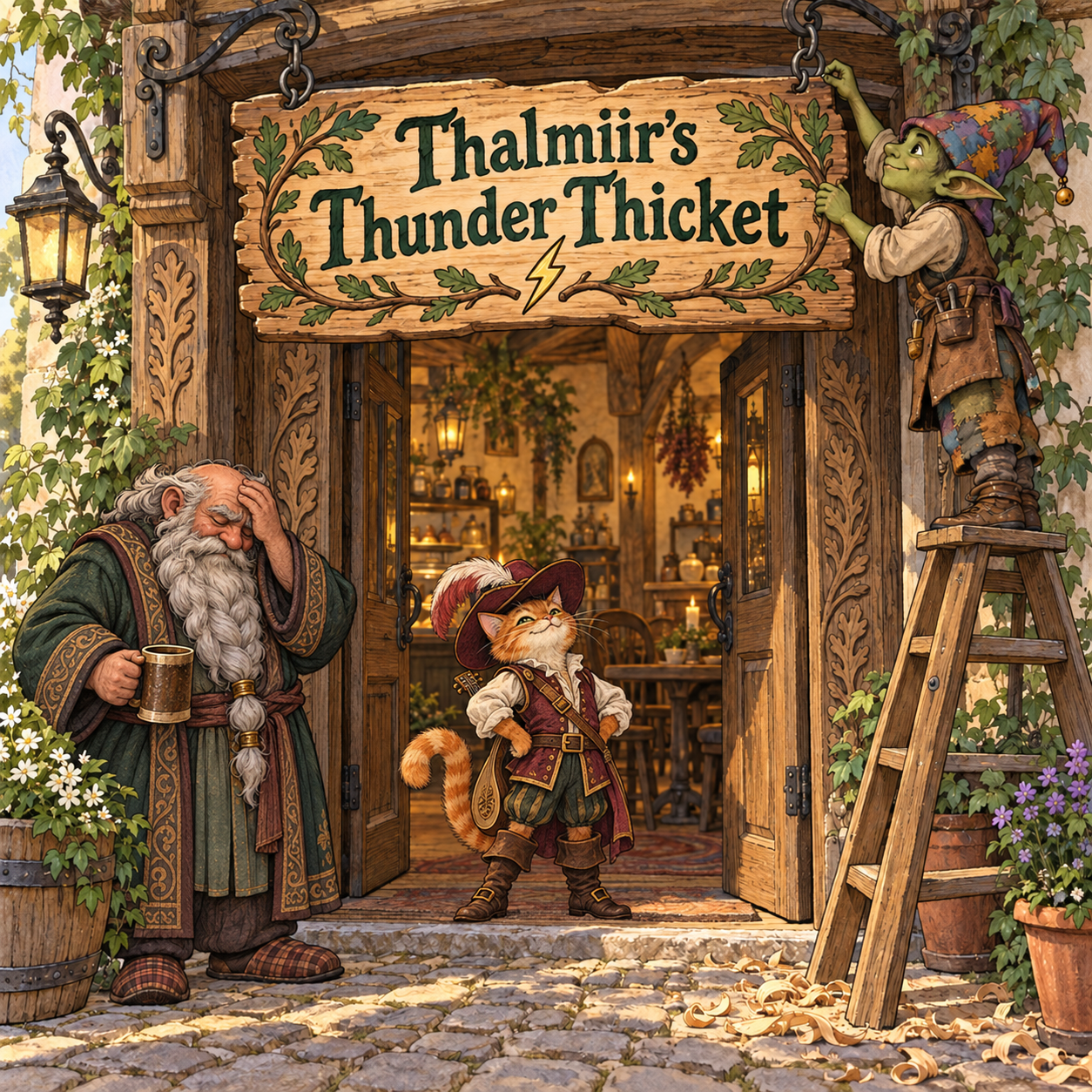
The door had scarcely announced a visitor before Bartholomeow was hurrying through the upstairs offices, already imagining customers. He swept through the advertising agency, passed the construction office, and reached the lounge with all the urgency of a man upon whose punctuality a commercial empire depended. There the elevator obliged him to stand still. It descended at its own unhurried pace, giving his enthusiasm nowhere to go until the doors opened and he burst into the lobby of the establishment that had, until very recently, belonged to Destiny.
Janine stood outside. For a moment, neither of them offered quite the greeting the other expected.
“Bartholomeow?” Her gaze moved past him into the building. “What are you doing here?”
“Welcome to Thalmiir’s Thunderdome.”
“I don’t understand.” She hesitated. “Destiny’s not here, is she?”
“Oh, no.”
“She’s dead,” Hat supplied.
Janine looked at him. “You’re sure?”
There were several subjects on which the new management had yet to reach a firm decision. This was not one of them.
“We’re really sure.”
“That’s…” Janine drew a breath. “That’s great news.”
“Are you looking for employment?”
The question left her briefly speechless. Bartholomeow took the opportunity to invite her inside and offer coffee. They had not yet properly staffed the café, but he could manage something.
“Could you make it six coffees?”
“You’re really thirsty.”
She leaned back through the doorway and beckoned.
Five figures approached with the awkward caution of people returning to the scene of something they had survived. Relief had brought them this far; memory made the last few steps difficult. One half-orc crossed the threshold, stopped, and stepped outside again. He looked at the doorway as though it had performed a trick. Then he stepped back in.
Bartholomeow abandoned the coffee long enough to join him, turning the small passage backward and forward into a jig. For a few moments the entrance to Destiny’s former emporium hosted a performance of uncertain artistic merit and considerable personal significance. The half-orc could leave. He could come back. He could leave again, and no one stopped him.
Eventually there was coffee, and Janine began to explain. They had been here so long. Then, suddenly, they had been able to go, and had discovered that freedom did not necessarily include somewhere to sleep.
“But what happened?” she asked. “You’re the bakery people. You killed Destiny?”
“It was a hostile takeover,” Bartholomeow said.
Hat offered the simpler explanation that Destiny had seemed very bad.
“Justice,” Bhakris corrected, with the gravity of someone unwilling to let a perfectly respectable act of vengeance disappear beneath commercial terminology.
“Exactly. Bhakris can tell you all about justice. I think of it as an opportunity to diversify.”
The six former employees exchanged looks. Whatever passed between them was quieter and more consequential than the explanations they had received. At last they appeared to accept that justice had arrived from the bakery, and that its precise relationship to diversification could wait. What could not wait was the question of their beds.
“Are you offering to let us stay in the staff room?” Janine asked. “In our old beds?”
Contracts were proposed. Employment, accommodation, accommodation as part of employment: Bartholomeow saw several promising arrangements. Hat could attend to the documents. Bhakris wanted profitable work identified before the conversation wandered too far into the merely amusing.
“We need funds for armor,” he reminded them.
Janine listened, gathered herself, and tried again. “We’re good at running this place. But there are things we won’t do anymore.”
The words came with an effort that lent them more weight than their volume suggested. They could operate the café. They understood the greenhouses. If the doctor was willing to continue making the necessary preparations, the cosmetics business could survive. Destiny’s special projects were another matter.
Those projects had largely involved blackmail.
Bartholomeow assured them that the enterprise was entering a new phase, although he was not prepared to say that blackmail had no place whatsoever in its future. The employees conferred again and returned with a more carefully limited demand: participation in such activities must be voluntary, considered separately for each person and each occasion.
And there would be no taking pieces of them. No hair, no teeth, nothing of that sort. Giving Destiny hair had been part of how their troubles began, and at the first suggestion of unusual contractual provisions, their expressions closed.
“That’s firm,” one of them said.
Then, almost at once: “If that’s all right.”
It was becoming difficult to miss the shape of the negotiation. These were capable people trying to bargain for conditions they scarcely knew how to imagine. Their opening ambition was something better than bondage. Even their refusals came half-prepared to apologize for themselves.
Bartholomeow explained that the establishment would have open hours and closed hours.
“What would we do during the closed hours?”
“That’s your time.”
They waited for clarification. “You could drink coffee,” he suggested, “instead of serving it.”
“So we’d be testing new products?”
“If you wanted to.”
They found that easier to understand. None of the bad products, though. They were quite clear about that.
Bhakris eventually proposed eight hours for sleep, twelve for work, and four for themselves. Eight hours of sleep met with cautious approval. Four hours of themselves remained a perplexing prospect.
“They don’t have to be consecutive,” Barnaby observed.
Somewhere in the midst of this effort to explain leisure, Thalmiir shuffled past in a robe and slippers. He disappeared into the kitchen and returned carrying a mug of coffee stout, conducting a practical demonstration of personal time without interrupting it to offer instruction. The negotiations continued around him.
By degrees, the newcomers became more than six frightened people gathered over coffee. Bradford handled stores and the movement of goods. Dor’dyn, the half-orc who had tested the door, tended the greenhouses alongside Lorian. Janine belonged at the front of the house; Thalia ran the café. Selfess had served as Destiny’s assistant.
Destiny had chosen them well. That, too, was part of the ugliness of it. They were intelligent, competent, and pleasing to look at, useful both for the work they performed and the impression they made upon important visitors. Even the gardeners’ hands looked remarkably soft.
Once the prospect of familiar beds became real, Selfess seemed to find a piece of herself she knew what to do with. She produced a notebook.
“Who, exactly, do we report to?”
Bartholomeow began an answer.
“And what is the reporting structure?”
He continued beginning it.
“We should also discuss security.”
That subject was easier to approach, if not easier to settle. The former guards had been horrible, intrusive, and appallingly dressed. Selfess had objections on all three counts.
“We were planning to invite a dragon,” Bartholomeow said.
Her pen stopped.
“A dragon?”
“She likes to be involved in things.”
Bhakris would also oversee security, under his developing title of Vice President of Vengeance.
“Security,” he explained, “is a subset of vengeance.”
Selfess looked from one to the other, then down at the notebook. Previously, six guards had been sufficient to provide protection at all hours. She conceded that a dragon might alter the calculation, though she had not yet seen this particular dragon.
There followed the more immediate question of what the business actually did.
“Undefined and yet profitable enterprises,” Bartholomeow suggested.
Selfess wrote something down.
“Shall we operate the café?”
“Yes.”
“And continue selling cosmetics?”
After some discussion, the answer became yes to that as well. The staff understood the work. Without the burden of helping Destiny ruin her customers and extract their entire fortunes, ordinary sales might even prove manageable.
Bhakris reserved judgment on the ruining of customers until their moral character had been established. If they were wicked, the matter looked rather different. Selfess accepted this as another item requiring executive clarification.
The café and cosmetics shop would be the beginning. Today would be devoted to reorganization, with a possible reopening tomorrow. The sign needed changing. So did the explanation for Destiny’s absence.
“Under new management,” Hat said.
And if anyone specifically demanded Destiny?
“She’s exploring opportunities on another plane of existence.”
Bartholomeow demonstrated a second approach by becoming a smaller version of the former proprietor and attempting her voice. Selfess watched this with professional attention and increasing concern.
Before they began handling Destiny’s special clients, she advised, they ought to settle security in greater detail. These clients were wealthy, accustomed to urgency, and inclined to consider their own time very valuable. Other people’s time concerned them less.
“Real arseholes,” Bartholomeow translated.
Selfess flushed a deep purple.
“This is an internal meeting. Don’t put that in the notes.”
She struck out a line.
Thalmiir’s Thunderdome became Thalmiir’s Thunder Thicket as the conversation developed, but its obligations were less susceptible to revision. Moonflower Creations still needed attention, there were debts to Sterling, and Brock Hardbark’s demands were growing more insistent. He remained dissatisfied with the protection they had supplied to Hardbark Meadows, or, more precisely, with the protection they had ceased supplying when they had gone elsewhere.
Mention of the campsite produced a brief flowering of possible solutions, most of which involved persuading someone else that the arrangement would benefit them. The most promising subject was the bandits.
Bhakris remembered the men they had encountered outside the town: their uncertain leadership, their difficulty keeping themselves fed, their dissatisfaction since their former leader’s disappearance. He had urged them to abandon thievery and seek honest work. Now, rather unexpectedly, he had honest work to offer. Some of it would involve standing at doors and looking capable of violence.
“Distinguished security guards,” he suggested.
“Personal security advisors,” Bartholomeow improved.
Waer’dara regarded the proposal with suspicion. They were hiring criminals to provide security? Former land pirates, the others explained, as though the distinction might comfort her.
There were dozens of them, which raised a difficulty. The franchise could hardly afford dozens of additional wages. But perhaps their services could be sold. Guards for the Thicket, guards for the bakery, guards for the campsite. A separate department under Bhakris, available for hire. Once Bartholomeow began describing the arrangement, an unaffordable collection of hungry bandits rapidly acquired the appearance of a business opportunity.
Hat suggested shares instead of gold.
“Non-voting shares,” Barnaby added.
The shares would become theirs after a suitably encouraging period of service. Six months became four years with remarkable speed. The generosity of this arrangement would need to feature prominently in the recruitment materials.
There was also accommodation to consider. Hardbark might house the new guards in exchange for protection, which would settle the outstanding dispute. Or, if enough guards occupied the campsite without paying for it, his business might become distressed enough that buying it would be affordable. Each possibility improved upon the last in the eyes of someone at the table.
None quite removed the difficulty that two operations across the river were paying astonishing wages to anyone who appeared. Those employers, however, were not offering a long-term future, or shares, or muffins.
The muffins brought the discussion back to Saffron. Her oven could supply the café, but Barnaby objected to any arrangement that would shut her away in a kitchen while all the pleasure of serving her customers happened somewhere else. Saffron enjoyed seeing people eat what she had made. They had seen that. Remove it, and they might discover how little interest she had in becoming the unseen foundation of their expanding enterprise. Keeping her happy was sound business as well as courtesy.
Bhakris took responsibility for making the two establishments work together. Bartholomeow claimed the advertising agency, where he would prepare an irresistible invitation to honest employment for men whose relationship with honesty had previously been flexible.
Thalmiir, meanwhile, proposed going outside.
“Business isn’t made in a stuffy building,” he said. “It’s made where the resources are.”
He would explore their territory, look for opportunities, and identify threats. The idea had much to recommend it until the likely expense was considered: four hundred gold. For a little while the expedition existed in the air between them, bold and useful and entirely beyond their means.
Then Thalmiir found another way to help. Over the coming tenday, he dealt with the people who still associated the building with Destiny. They approached cautiously, some wanting products, some wanting assurances, and some evidently wanting to know whether an arrangement they could not bring themselves to describe had survived the woman who imposed it. They circled the question with impressive care. Would the new proprietors be continuing the old understandings? What, exactly, had changed?
Thalmiir knew better than to say that they did not yet understand what Destiny had held over whom.
“A new era is beginning,” he told them. “We’re forging new relationships. The past is behind us.”
Some departed reassured. Others seemed to find the same words deeply troubling. Either way, he kept the conversations moving and the business working. Diplomacy, he discovered, did not always require saying much. Sometimes it required leaving people enough silence to frighten themselves.
Upstairs, Bartholomeow was assembling a brighter future out of paper, ink, and carefully selected expectations.
The advertising room rewarded occupation. Equipment filled its corners; ideas seemed to follow one another more readily there. He had the means to make woodcuts, the means to print them, and a cause in which he could believe with magnificent flexibility.
The proposed department of personal security advisors would offer a partnership, a future, a chance to belong to something growing. The wages required delicacy, the shares emphasis, and the four years particularly attractive lettering.
He prepared arguments for every likely objection and advantages for every imaginable recruit. A smiling goon appeared in a woodcut, one thumb raised in wholehearted approval of a career he had not yet begun. The booklets were excellent, and so were the posters.
By the time Bartholomeow had finished shaping the pitch, the former bandits’ possible employment no longer looked like a request to stand guard for uncertain compensation. It looked like a rare opportunity they would regret missing. All that remained was to approach them.
Elsewhere upstairs, Barnaby pursued a less public means of improving the franchise’s finances. Destiny’s ledgers lay open in the executive office.
At first glance they offered the familiar comfort of orderly writing. Closer study revealed how carefully that order concealed its meaning. Different clients appeared to have required different ciphers. Some passages yielded with patience; others had been protected more thoroughly.
Barnaby settled in. Sitting and reading was work he understood.
Over the tenday, patterns emerged. Marks ceased to be marks and became references. Entries that had seemed unrelated acquired connections. He began to distinguish the habits of concealment from the information concealed.
Destiny’s books held more than accounts. She had preserved the private vulnerabilities of important people in and around Seacomber, arranged for use. Six secrets finally came clear: whose they were, and why their owners had paid to keep certain facts unspoken. Barnaby now had both.
Before the tenday was over, one of those discoveries became an immediate opportunity. A visitor came to the establishment; Barnaby knew enough of that visitor’s circumstances to secure a hundred gold for the franchise. No elaborate decision on the future of blackmail preceded the transaction. The gold arrived, and five secrets remained.
Downstairs, Thalmiir continued explaining that the past was behind them.
Hat and Waer’dara spent their days in a room that became a forest whenever they stopped insisting otherwise.
Concentration revealed its boundaries. They could remind themselves that they were upstairs, indoors, in a building with a café beneath them and an advertising agency nearby. But let the mind relax, let the gaze settle without searching for corners, and the room opened into something ancient and trackless.
At its center stood a flower three feet across. Its petals shimmered. Bright motes rose from it, now like pollen, now like dust catching impossible light, their colors changing as they drifted.
Hat had spoken of finding berries. The flower soon occupied all his attention.
At first the forest sounded as a forest should. Leaves stirred. Birds called. Somewhere unseen, water passed over stones. Then the birds changed. Another time, the stream was gone and wind moved high through treetops. Rain followed. Later came the peculiar hush of snowfall, the world softened and held still beneath something neither of them could see. The room remained green.
Hat listened harder. The sounds were convincing, but they did not always belong to the place around him. The rain had no visible source. The snow did not touch the leaves. Thinking about the rain, he heard it return.
He sat very still. Then he imagined a jungle. Insects began to rasp and hum. Tree frogs called through the wet, crowded darkness of somewhere else. Then snow again, and the sound diminished to that deep, muffled quiet.
Waer’dara watched the flower while Hat tested another thought, then another. There was delight in the discovery, but also something that invited restraint. An ornament had become an instrument, and they had only just found where to put their hands.
A room like this could be sold as a retreat. People would pay to sit peacefully among the sounds of distant forests. Hat wanted to know how distant. He began thinking of particular places, and the flower answered with greater precision than he had expected.
And then, among the leaves and birdcalls, someone spoke.
The first words escaped him. His attention shifted toward their strangeness, and the conversation slipped away with it. He tried again. Forest followed forest. Voices appeared in fragments, embedded in the living sounds around them. Eventually Waer’dara leaned forward. Elvish. The dialect was unfamiliar, but she understood it. She turned to tell Hat, and from the flower, a voice interrupted its own conversation.
“Who said that?”
Waer’dara froze.
“What? Did you say something?”
“It was in a strange language.”
She got Hat out of the room.
“They can hear us.”
“That’s great. We’re talking to the flower.”
“It goes both ways.”
“Who are they?”
“I don’t know.”
That, to Waer’dara, was the part deserving attention. Hat thought it an excellent reason to ask.
Their hurried emergence brought them into Bartholomeow’s domain at a moment of artistic importance. He looked up from a poster.
“You’re just in time! Get the press! Get the clamps!”
“We’re talking to flowers,” Hat said. “We don’t have time for that.”
“Then get back in the flower room. I don’t need you here.”
“Mysterious elves,” Waer’dara clarified.
The distinction failed to displace the poster from its place in Bartholomeow’s priorities. They returned, and Waer’dara approached the bloom and tried a greeting in Elvish.
“Hail and well met, fellow elves?”
No answer. She waited through the forest sounds. Nothing.
“I swear there were elves.”
“I believe you,” Hat said. “I heard them.”
She let out a breath. “Thank you.”
They began searching again. The next voice spoke Common.
“Hello?” Waer’dara ventured.
“Hello? Who’s there?”
“Hat. Who are you?”
A pause.
“Where did you learn to talk, flower?”
It took some effort to establish that the unseen speaker believed the voice was coming from nearby foliage. Their attempts to clarify this only increased the suspicion.
“You can’t trick me, talking flower. My grandmammy told me not to trust talking foliage.”
“She had a point,” Waer’dara admitted.
“Where are we?” Hat asked.
“In the undergrowth!”
“Yes, but where are you and me? The flower.”
“How can you be a flower who doesn’t know where it is?”
“I’ve been sleeping.”
The stranger offered the name of a place neither recognized. It might have been a village, a region, or simply a local word for forest. Then, having established that the flower was untrustworthy and geographically confused, the speaker proceeded to demand wishes.
“No,” said Waer’dara.
“What if I pull one of your petals?”
“Then you’ll be a bad person.”
“You’ll feel flower vengeance,” Hat warned.
“I am a bad person. I want my wishes.”
“Bad people shouldn’t get their wishes granted.”
The sounds blurred, and another forest replaced that one. They had learned something, although it was difficult to say whether it concerned the flower or people.
Hat turned his thoughts toward a clearing he remembered in the Feywild. Silver leaves moved against one another. Pixies snickered. A delicate chiming gathered in the room, silver bells stirred by the little breezes of darting wings.
For a moment he simply listened. The sounds carried the intimacy of memory without its distance. He did not have to reconstruct every detail; somewhere beyond the flower, the place seemed to be continuing without him.
“I wonder if we can go there.”
Waer’dara looked at the bloom. Hat began to climb. It was large enough to invite the experiment, but the petals bent beneath him in a manner that rapidly discouraged further inquiry. Whatever passage the flower offered to voices, it did not seem ready to accommodate Hat. He backed away before he damaged it. The chiming continued.
Over the following days, they grew more adept. Familiar forests could be found again. With greater effort, even the barrier between planes proved permeable to sound. Conversation remained less dependable. In the Feywild they heard voices, but no one answered. Whether the speakers could not hear them or merely knew better was impossible to establish. Hat could hardly fault anyone for declining a conversation with a plant that had suddenly begun asking questions. Such things attracted the extraordinarily powerful, the extraordinarily foolish, or those unfortunate enough to mistake themselves for the former.
For all their patience, they reached none willing to reply. Then, near the close of the tenday, the flower carried voices they could recognize.
Elsewhere in the building, the reorganization was beginning to resemble a working establishment. Bhakris reached a satisfactory arrangement with Saffron. More ingredients would allow her to bake twice as much while continuing to serve the guests and customers of Moonflower Creations. The new café would receive its share without depriving her of her old patrons.
Moving the food between the two locations remained troublesome. Distance and lifts complicated the journey. Agreement was one thing; getting fresh baking where it belonged was another. Still, there was a plan, and people who knew their part in it.
Dabshabah was especially pleased with hers. Most of her hoard moved to the executive office. The position offered a suitable place from which to embody the magnificence of the enterprise, receive admiration, and survey her minions from the balcony. The balcony was a considerable improvement, and her contentment was noticeable.
Nathaniel’s usefulness was less immediately apparent. He had energy, willingness, and rather more time than his remaining responsibilities required. Someone would have to find a better occupation for him.
And Selfess’s warning about security kept finding small ways to justify itself. Visitors arrived whose expectations had been formed under Destiny. They brought unpleasant assumptions about the deference owed them and the treatment they ought to receive. Nothing happened that the companions could not handle, but that qualification was becoming the trouble. The companions could handle it. Bradford, Janine, Dor’dyn, Lorian, Selfess, and Thalia could run the business, but they could not be expected to stand against every unsavory caller who regarded a change in ownership as an invitation to test the doors.
Before the adventurers could safely leave for any length of time, the promised guards would have to become actual guards. Bartholomeow had very good materials ready for precisely that purpose.
But upstairs, in the forest, Hat and Waer’dara had found a different audience. Pandora and Ulbricht did not immediately believe them. There was some understandable suspicion that a forest hag had contrived the entire encounter. Voices issuing from flowers did little to establish anyone’s trustworthiness. Questions passed in both directions. Details were supplied that an impostor ought not to know. Familiar events acquired familiar answers. Gradually, doubt yielded.
They were speaking to the flower sprites who had tasked Barnaby with obtaining the orchid. And the sprites were speaking to them.
“We only left you yesterday,” came the astonished response. “We’ve only just arrived.”
Hat and Waer’dara had spent the tenday learning to use the flower. The discrepancy hung briefly between the two places, as strange as the conversation itself. But Pandora and Ulbricht had news more immediately inviting than the behavior of time.
Stories of the companions’ bravery were spreading among their people. Their service had been remembered. Their queen would surely wish to speak with them, and when she did, it would be appropriate to request a boon.
Waer’dara’s attention sharpened. “A boon.”
This sounded promising. Could they restore the connection tomorrow?
“What time?” she asked.
“When the sun’s dawning light kisses away the last of the dew on the sapling.”
She considered this. “We’ll call that eight in the morning.”
Approximately, then.
There was an appointment to prepare for, and a queen to address, and the enticing question of what might be asked in return for their service. The company’s needs suggested one answer with weary consistency: money. Money for armor, money for wages, money for all the things that had seemed simple until someone named their price.
Pandora, hearing the direction of their hopes, gently corrected them. They might request a boon. The queen would determine its nature. Her Majesty was magnificent and generous, and would surely grant something befitting the service they had rendered.
“You could try asking for cash,” Ulbricht added, “but I don’t think she has any.”
Waer’dara accepted this with the restraint of someone who had briefly glimpsed a solution to several problems and watched it turn into a different sort of opportunity. Gold was simply useful where they were. Nevertheless, a queen’s favor was a queen’s favor.
By the end of the tenday, the old emporium held fresh baking, carefully printed promises, five unspent secrets, and a dragon who approved of her balcony. Six people had returned to beds they once could not leave, and were beginning the unfamiliar business of having hours to themselves. Debts and dangerous callers remained, and the guards existed chiefly in Bartholomeow’s persuasive account of their future.
And in a room upstairs, a great flower shimmered amid the sounds of distant trees.
Tomorrow, when dawn had finished with the dew, or at eight, which was easier to put in a notebook, they would speak to a queen.
Bartholemeow went to answer the door at the party’s newly acquired headquarters. Starting on the second floor, he chose the elevator rather than the stairs, passing through the internal advertising agency and construction office to reach the lounge. Hat accompanied him. The ride between the first and second floors was much shorter than the elevator’s journey to the sub-basement. In the downstairs lobby, Bartholemeow found Janine, who was surprised to see him. He welcomed her to “Thalmiir’s Thunderdome.” Janine immediately asked whether Destiny was present, and Hat told her that Destiny was dead. After confirming that he was certain, Janine called this great news. Bartholemeow invited Janine inside, asked whether she was seeking employment, and offered coffee. Janine requested six coffees, then signaled to five other former employees waiting outside. They entered with a mixture of fear, relief, and visible trauma. One of the returning employees, a half-orc, stepped into the building and then back outside, apparently checking that he could leave whenever he wished. Bartholemeow briefly abandoned the coffee preparation to join him in a jig in the doorway. Over coffee, Janine explained that the employees had spent so long at Destiny’s establishment that, once they were suddenly free to leave, they had nowhere else to go. She recognized the party as the people associated with the bakery and struggled to understand how they had come to kill Destiny and take over her business. Bartholemeow described the change in ownership as a hostile takeover and an expansion of the party’s enterprise. Bhakris characterized it as the delivery of justice. The former employees exchanged looks and appeared willing to accept that the party had arrived to deliver justice without requiring further explanation. Bartholemeow explained that the business would no longer be Destiny’s Lifestyle Emporium and offered the former employees work. When they reiterated that they had nowhere to live, the discussion turned to accommodation at the campsite or in their former beds in the establishment’s staff room. Hat suggested that the employees could rent sleeping space or work in exchange for it. Bartholemeow proposed having the party’s documancer prepare an employment contract, a rental contract, or an arrangement combining work and accommodation. Bhakris recalled that the party had received a bill over its failure to provide security at the campsite. The possibility of connecting the employees’ housing needs with that unresolved obligation was raised, but no arrangement with the campsite was made during this discussion. Bartholemeow took the lead in negotiating with the returning staff. Possible duties included staffing the café, cleaning, advertising, and working with potions or other concoctions. Bhakris emphasized that the party needed profitable activities, particularly because he wanted money for armor, and wanted to keep the discussion focused on ideas that could earn funds. Janine said that the employees knew how to run the establishment, including the café and greenhouses. She was uncertain whether Dr. Melville would still be interested in making Destiny’s concoctions. She also made clear that the employees did not want to resume all of Destiny’s “special projects.” The special projects were identified as primarily involving blackmail. Bartholemeow said that the party had not definitively decided whether to continue that aspect of the business, although it was not their immediate direction. The employees asked to decide individually, on a case-by-case basis, whether they would participate in blackmail. The negotiations revealed how completely Destiny had controlled the staff. They had effectively been her slaves, subject to her whims, and were bargaining from the position of hoping for something better. Their immediate need for somewhere to sleep left them with little negotiating power. The employees became especially uncomfortable with any suggestion that the party might require hair, teeth, or other pieces of their bodies. Giving hair to Destiny had been part of how they became trapped in their previous situation. They insisted that their new employers would not be entitled to any such pieces. Bartholemeow explained that there would be opening and closing hours and that employees would not work during the closed hours. The idea of time for themselves was unfamiliar enough that they initially interpreted drinking coffee for pleasure as testing products for the business. They were willing to test products, provided those were not the bad ones. Bhakris proposed a daily schedule of twelve hours of work, eight hours of sleep, and four hours of personal time. The employees were pleased by the prospect of eight hours to sleep but uncertain what they would do with four hours of their own. Bartholemeow clarified that any future blackmail operation would not involve blackmailing the employees themselves. Their participation would depend on their individual interest and consent. The party discussed treating blackmail as a special-project category, with Bhakris suggesting a tribunal for individual cases, but no formal blackmail department was established. While the negotiations continued, Thalmiir shuffled through the background in a robe and slippers. He went to the kitchen and returned with a mug of coffee stout, treating it as his morning beer. When Bartholemeow asked whether any of the employees had experience with primal forests, they pointed to their greenhouse work. The returning staff were introduced with their previous responsibilities: The staff appeared intelligent and capable, having been selected both for their professional abilities and for their suitability around Destiny’s wealthy clientele. They were attractive and well groomed; even the greenhouse workers showed little sign of rough hands or physical wear. The employees accepted the general prospect of returning to work under improved conditions and with somewhere to sleep. The finer details of their contracts were left unresolved, with the possibility that they might later seek to renegotiate matters not covered in this initial discussion. Selfess quickly resumed an executive-assistant role. She asked who the employees would report to, what the reporting structure would be, and how the party intended to handle security. She described Destiny’s former plant-monster guards as horrible and intrusive and objected to their outfits. Bartholemeow said that the party intended to invite a dragon to join them, although the dragon had not yet been brought to the new headquarters and her exact security role was uncertain. He also identified Bhakris as the head of security and “VP of Vengeance.” Bhakris explained that security was a subset of vengeance. Selfess said that six guards providing around-the-clock coverage had previously been sufficient. Although willing to trust the party’s judgment about Bhakris and the dragon, she was not yet assured that the new security arrangements would cover the establishment’s needs. Bartholemeow described the new location as an expansion of Moonflower Creations, which already combined a bakery with bed-and-breakfast possibilities. The former emporium would become the headquarters for additional profitable enterprises. Selfess recorded the evolving business name as still in progress. Asked for immediate operational decisions, Bartholemeow approved reopening the café and initially expressed doubt about continuing cosmetics sales. The party then examined whether the available staff could support both businesses. Including Nathaniel, the establishment had seven workers. Selfess explained that those seven, together with Destiny, had previously operated the entire business without additional help. The café could require two or three workers on busy evenings, and the new allowance for sleep and personal time would reduce how much work the staff could perform compared with Destiny’s expectations. Selfess explained that Destiny had concentrated on executive matters, blackmail, and developing new products. Destiny herself had also required considerable personal attention from her assistant. Bartholemeow suggested that Thalmiir might need some care and feeding, advising the staff to wait until after his first two coffee stouts before attempting much interaction. Bhakris placed personal assistance below the practical work of running the café, maintaining the perfumery, cleaning, and other business duties, while also extending the possibility of assistance to the rest of the party. Selfess considered executive assistance one of her strengths. She also believed the current staff could maintain the café and cosmetics shop. Continuing cosmetics production would depend on keeping the greenhouse and production arrangements working and, probably, on Dr. Melville’s cooperation. New products would matter to the cosmetics business’s long-term success. Selfess described Destiny’s approach to acquiring customers as reducing people to husks of their former selves while extracting all their wealth. The staff had played supporting roles in that process. With less time spent enabling Destiny’s exploitation, they expected to have sufficient capacity to keep the ordinary businesses running. Bartholemeow distanced the party’s general business plans from Destiny’s treatment of customers. Bhakris qualified that position by saying that wicked or evil people could still be suitable targets for vengeance, with Destiny herself serving as the example. The party agreed to begin with the café and cosmetics business. Bartholemeow said that they needed to consult Thalmiir, who had been handling the ledgers, to ensure that income would cover their fixed expenses. Rather than reopen immediately, the party designated the current day for restructuring and discussed a soft launch the following day. Preparations included changing the sign and cleaning blood from the walls. Selfess asked how to explain Destiny’s sudden absence and the party’s arrival. Suggestions included “under new management” and saying that Destiny was exploring opportunities on another plane of existence. Destiny’s special clients presented a separate concern because some would arrive urgently and insist on seeing her personally. The party proposed referring such visitors to them. Bartholemeow specifically offered to handle these clients and shapeshifted into a smaller version of Destiny while attempting to mimic her voice. The party discussed transitioning those clients to its new products and services. Selfess advised settling the security arrangements before beginning to handle them, explaining that some clients judged a business’s security by the visible number of guards. Hat suggested hiring goons. Selfess indicated that having both capable guards and sufficient numbers would be preferable. She also explained that Destiny’s wealthy special clients could be difficult, regarded their own time as extremely valuable, and did not necessarily provide useful advance notice before arriving. With the café and cosmetics operation provisionally organized, the discussion shifted to the relationship between the new headquarters and Moonflower Creations. Hat proposed featuring Moonflower’s pastries in the new café. Moonflower Creations’ existing staff consisted of Saffron, Gorka the goblin, and Dabshabah the dragon. The party had last visited only the previous day, when the situation there had been relatively stable. Brock Hardbark, proprietor of Hardbark Meadows, remained an unresolved problem. He had been sending increasingly urgent demands for repayment over the party’s failure to fulfill its security obligations. Bartholemeow suggested renegotiating the contract in the party’s favor, with Hat helping rewrite the paperwork and Bhakris accompanying them. The party considered whether Moonflower Creations should continue selling directly to the public or supply only the new café. They also discussed which property would serve as their principal home. Hat favored the new compound because of its facilities and the rooms the party had established upstairs. Moonflower Creations was clarified to be a former inn whose kitchen and common room had been used for the bakery. The party had occupied upstairs rooms, and Dabshabah had established her lair in the third-floor attic. The newer facilities, including the executive office and primordial forest conduit, were located upstairs in Destiny’s former manor. During this discussion, the headquarters’ name was corrected from “Thunderdome” to Thalmiir’s Thunder Thicket. Bhakris raised the possibility of recruiting the bandits the party had previously encountered, referred to as Thurman’s Thieves or the Oak Tree Bandits. Their location was less than a day’s sail from Secomber, or approximately two days away on foot. Bhakris recalled that the bandits needed employment, better leadership, and a reliable way to earn money. He had previously urged them to abandon theft and find honest work in Secomber. As an employer, he now saw an opportunity to fulfill that promise by hiring them for security. The party recognized that recruiting additional staff would increase expenses while they still owed money to Sterling. They nevertheless discussed possible ways to turn the bandits’ abilities into income, including work beyond guarding the headquarters. Hat’s skills as a documancer and the headquarters’ internal advertising agency were identified as useful resources for preparing an employment offer. Bhakris wanted to recruit former bandits as guards, with a more respectable official title to be determined. The bandits’ circumstances were recalled in more detail: their previous leader had vanished shortly before the party encountered them, and the replacement leader had struggled to keep everyone fed and occupied. Some members had expressed nostalgia for the former leader. The party revisited its suspicion that the missing leader might have become the bear encountered during that earlier adventure. That remained a suspicion rather than an established fact. It was confirmed that strange animals had been present and that the party had fed the defeated bear to the bandits. There had been dozens of bandits. Supporting all of them as additional employees did not appear financially realistic without further analysis and a way to make their work profitable. Proposed assignments included guarding the Thunder Thicket, Moonflower Creations, and Hardbark Meadows. Bartholemeow suggested a “Rent-a-Goon” subsidiary that could sell security services to others. The party discussed paying recruits through shares or profit sharing rather than immediate wages. Suggestions included non-voting shares and a four-year vesting period, with the offer presented as a generous long-term opportunity. These were recruitment ideas rather than completed employment agreements. The campsite dispute was revisited. The party had agreed to guard Hardbark Meadows, left to help the bakery, and then gone on to other business, including the swamp expedition. Their promised security presence had consequently disappeared. Hat proposed assigning some former bandits to guard the campsite in exchange for permission to stay there, reducing the need to pay gold. He also suggested that the arrangement could eventually lead to the party acquiring the campsite. The campsite probably had enough physical space for the bandits, but it had been mostly occupied when the party last visited. Bhakris also noted that recruitment might not attract the entire group and that the bandits’ circumstances could have changed since their last encounter. The party discussed filling the campsite with guards who received accommodation in exchange for security. They considered how such an arrangement might satisfy the security obligation while leaving Brock with fewer paying customers, potentially creating an opportunity to buy the campsite if his business faltered. No such plan was put into effect. A further recruitment difficulty was recalled: two operations across the river were paying extremely high salaries to almost anyone who appeared. Those competing employers were part of the reason Brock had struggled to hire guards. The party considered emphasizing shares, long-term prospects, and access to good muffins as attractions of their own employment offer. Recruiting a large number of people would also require increasing food production. The Thunder Thicket’s café already had a kitchen, although it did not have a known magical oven like Saffron’s. The possibility of expanding baking facilities was discussed. Barnaby emphasized the importance of keeping Saffron happy. She seemed to enjoy seeing customers’ pleasure when they ate her food, rather than simply baking for money. Restricting her to a kitchen while selling all her products elsewhere might undermine what she liked about her work. The party agreed to spend the next several days organizing its businesses and pursuing downtime activities. The new upstairs rooms offered additional options for that work. The internal advertising agency provided a passive +3 bonus to relevant downtime or franchise activity checks. Its active ability, “While the Truth Is Still Lacing Its Boots,” used Persuasion or Insight at one of three difficulty tiers to prepare a benefit for the next relevant franchise roll. Successful advertising work at the three tiers could grant advantage, advantage plus 2, or advantage plus 5. Activities relevant to the franchise would be treated broadly as eligible franchise rolls. The primordial forest conduit potentially allowed the exchange of personal goods and services with the flower fairies, but that benefit depended on making contact with them. Its audience-related activities were described in tiers: making contact, obtaining a quest, and requesting a boon. Before using the conduit’s other capabilities, someone needed to spend downtime learning how it worked. The initial requirement was a DC 10 Persuasion or Nature check. Establishing the new franchise location also required someone’s time. After considering formal restructuring rules involving workweeks, expenses, and reduced monthly costs, the activity was treated as the practical work of setting up the new operation without requiring a restructuring check. Bhakris volunteered to lead the restructuring, provided someone else handled the advertising work needed to support recruitment. Bartholemeow agreed to take responsibility for the advertising agency and selected its most difficult challenge. Bartholemeow described the intended business as a department of personal security advisors, reporting to the VP of Vengeance and available for customers to hire through the franchise. The immediate advertising task was to create the materials and persuasive narrative needed to recruit the former bandits. It was clarified that preparing the advertising campaign would not itself recruit the guards or establish the entire department. The work would improve the party’s later attempt to persuade the bandits to join. Bartholemeow developed pitches, graphics, posters, a recruitment booklet, and favorable rumors. The proposed message emphasized partnership, shares in the business, and long-term benefits, including the discussed four-year vesting period. Against a DC 20 challenge, Bartholemeow rolled 26 on Persuasion. His work was a strong success, producing excellent arguments and promotional materials. One image featured a happy-looking goon giving a thumbs-up in support of the Thunder Thicket. The advertising agency supplied the equipment Bartholemeow needed, including woodcut production facilities. He immersed himself in preparing the recruitment campaign. The successful campaign granted the franchise advantage and +5 on its next relevant roll. The benefit belonged to the franchise, rather than being restricted to Bartholemeow personally. The headquarters’ available rooms were clarified as the lab office, executive office, lounge, construction office, internal advertising agency, and primordial forest conduit. The party did not have an R&D laboratory; advertising had been selected instead. Thalmiir initially wanted to explore the surrounding territory for resources, opportunities, and threats. He preferred getting out into the world to remaining inside while the others prepared figures and recruitment materials. The formal Explore Territory activity would cost 200 gp per franchise rank for one workweek. As a rank-two franchise, the party would need 400 gp for the basic expedition. A Survival check would determine its outcome, with possible bonuses from relevant specialists, extra time, or additional spending. Given the franchise’s financial situation, Thalmiir decided that the expedition was not currently viable. No exploration expedition was undertaken. The construction office was considered as another possible activity. Its room-redrafting function would replace an existing room rather than simply add a new one. With the advertising agency already useful and no specific replacement desired, the party did not pursue a redraft. Thalmiir instead devoted his downtime to helping the business operate. His contribution added ten person-days of work toward business operations, improving the eventual end-of-month business roll. Thalmiir’s work focused on dealing with people outside the organization and explaining the change in ownership as diplomatically as he could. Some of Destiny’s former contacts were skeptical about transferring their business to the party. Several conversations revolved indirectly around Destiny’s blackmail. Visitors wanted to know whether her disappearance ended their obligations or whether the new owners would continue exploiting her information, but they avoided asking outright. Thalmiir did not disclose that the party did not yet understand the details of Destiny’s leverage. He spoke instead of a new era, new relationships, and leaving the past behind. Some people found this reassuring, while others appeared worried. His efforts nevertheless contributed effectively to keeping the business running. Hat chose to spend a ten-day investigating the primordial forest conduit. The lab office offered little immediate use because the party had no laboratories, and no construction-office project was needed. Another available project was deciphering Destiny’s books and notes. The party possessed her blackmail information but did not yet know how to read it. Bhakris supported investigating the records so that they would understand the people and obligations that might arrive at their door. Barnaby volunteered to study Destiny’s records. Waer’dara offered to help Hat investigate the conduit, and Hat accepted. Barnaby worked primarily in the executive office, examining Destiny’s books. He discovered that she appeared to use different ciphers for different clients, with some records more carefully protected than others. Deciphering the records was resolved with an Arcana check and degrees of success determining how many secrets Barnaby recovered. The reward structure was adjusted to use increasing numbers of d4s so that greater success would also improve the minimum number of secrets discovered. Barnaby rolled 16 on Arcana, then 6 on 2d4. He uncovered blackmail secrets concerning six important people in and around Secomber. The secrets were treated as narrative resources. The party could use them to obtain an advantage or pursue a goal when a suitable opportunity arose, with the precise application worked out when a secret was spent. Barnaby immediately used one secret to obtain 100 gp for the franchise from someone who came to the establishment. This left five unused blackmail secrets. Each remaining secret was expected to provide at least roughly 100 gp worth of value, depending on its use. Hat and Waer’dara began their investigation in the primordial forest conduit. The room felt like a dense, untouched forest. Concentrating revealed the room around them, but allowing their attention to relax made it seem as though they stood in trackless woodland. At the center stood an enormous flower, approximately three feet across. It shimmered and released sparkling motes of colored pollen, dust, or magic. Hat chose to investigate using Nature, in which he had a +7 modifier. Waer’dara’s help granted advantage, and Hat achieved a Nature result of 25, greatly exceeding the initial requirement. Their first important discovery was that the central flower responded to thought. At first, the sounds seemed like ordinary woodland ambience, but they began noticing changes that did not match the room’s apparent surroundings. The sounds included different birdcalls, running water, wind through treetops, heavy rain, and the muffled quiet of snowfall. Remembering a previously heard rainy forest caused the soundscape to shift back toward rain. Experimentation showed that imagining different types of forest could guide what they heard. Thinking about a jungle produced insects and tree frogs; thinking about snow brought the corresponding quiet. The room’s ability to provide immersive natural soundscapes suggested a possible business as a meditation space. Hat and Waer’dara continued exploring beyond that use and discovered that they could exercise increasingly precise control over the locations they heard. Eventually they picked up fragments of conversation. A conversation would fade when their attention shifted, but continued searching revealed other forest soundscapes containing people’s voices. Waer’dara recognized one conversation as an unfamiliar dialect of Elvish. Hat could not understand it; his languages were Common, Goblin, and Sylvan. When Waer’dara spoke to tell Hat what she had heard, one of the distant speakers reacted and asked who had spoken. The voices commented on hearing a strange language. Waer’dara realized that the connection transmitted sound in both directions. Waer’dara hurried Hat out of the room and explained that the people on the other end could hear them. Hat was enthusiastic about the discovery and wanted to learn who those people were. Waer’dara remained cautious because the identities of the listeners were unknown. The two interrupted Bartholemeow while he was finishing a poster. He initially assumed they had arrived to help with the printing equipment. Hat said they were talking to flowers, and Waer’dara clarified that they had heard mysterious elves. Returning to the conduit, Waer’dara greeted the distant speakers in Elvish. There was no answer; the people they had heard seemed to have departed. Hat reassured her that he had also heard the voices. Further searching found someone speaking Common. Hat and Waer’dara initiated a conversation, but the stranger assumed that a flower was speaking directly to them. The stranger was suspicious and said that their grandmother had warned them not to trust talking foliage. Attempts to explain or question the situation did not dislodge their belief that they were dealing with a talking flower. Hat asked where they were. The stranger answered that they were in the undergrowth and expressed disbelief that a flower would not know its own location. Asked where they came from, the stranger supplied an unfamiliar place name, which Hat and Waer’dara guessed might be a local word for the forest. The stranger demanded wishes and threatened to pull off a petal. Waer’dara said that doing so would make them a bad person, while Hat threatened “flower vengeance.” The stranger openly claimed to be a bad person and continued demanding wishes. The sound briefly became fuzzy, and the connection shifted into another forest soundscape. No wish was granted, and the stranger’s identity and location remained unknown. Hat next tried to tune the conduit to a remembered clearing in the Feywild. He concentrated on familiar sounds such as snickering pixies and silver leaves. The conduit produced the sound of pixies darting among silver bells that clinked and tinkled in the breeze from their wings. This demonstrated that the connection could reach beyond ordinary forests on the party’s current plane. Hat wondered whether the flower could transport them to the places they heard and began trying to climb into or onto it. The attempt appeared likely to damage its petals, so he stopped. No ability to travel through the flower was established. Over the ten-day, Hat and Waer’dara learned to focus on specific forest locations and hear them through the conduit. They heard fragments of speech from the Feywild but did not succeed in getting anyone there to answer. The lack of responses was consistent with Hat’s experience that speaking to an unexplained talking plant in the Feywild could be a bad idea. It remained unclear whether the people they heard could not hear them or were simply unwilling to respond. Near the end of the ten-day, Hat and Waer’dara contacted the flower sprites who had tasked Barnaby with obtaining the orchid. They eventually reached Pandora and Ulbricht. Pandora and Ulbricht initially suspected a trick by an evil forest hag. By exchanging information known to both sides, they established that they were genuinely communicating with the party, and Hat and Waer’dara likewise confirmed the sprites’ identities. The sprites said that they had left the party only the previous day and had only just arrived home. They reported that stories of the adventurers’ bravery and heroism were already spreading among their people. Pandora and Ulbricht expected their queen to want to speak with the party. Although she had not yet requested an audience at the beginning of the exchange, they advised that it would be appropriate to ask her for a boon when she did. The sprites asked whether the party could reactivate the connection the following morning. They described the desired time as when the dawn light removed the last dew from the sapling. Waer’dara interpreted that as approximately 8 a.m., give or take. By the end of the investigation, the conduit’s practical capabilities were established: the party could eavesdrop on forests they knew, reach forests on other planes with greater difficulty, and communicate with people through the connection. Distant listeners might initially assume that a strange or dangerous flower was speaking to them. The party finished the downtime with an appointment to speak with the queen of the flower pixies the following morning. Waer’dara raised the need to discuss what boon to request. Money was an immediate concern because the party needed funds for its businesses and other plans. Pandora clarified that the party could ask for a boon, but the queen would determine its nature. She expected the queen to provide something appropriate to the service the adventurers had rendered. Ulbricht said that the party could try asking the queen for money, but he did not think she had any. No specific boon was chosen or granted during the session. Bhakris’s restructuring work succeeded. He reached a satisfactory arrangement with Saffron for additional raw ingredients so that she could double her baking output, continue serving guests and patrons at Moonflower Creations, and supply the café at the Thunder Thicket. Transporting baked goods between the properties still required logistical work. The distances and lifts involved made moving supplies between them less straightforward than a simple local delivery. Dabshabah happily moved most of her hoard into the executive office. She was willing to occupy the space as a prominent figurehead for the organization and as a place to receive praise and adoration. The executive office’s balcony particularly pleased Dabshabah, giving her a place from which to survey her minions. She was noticeably more content with the new arrangement. By the end of the restructuring, the staff understood what they needed to do to keep the businesses operating. Nathaniel, however, had more time and energy than useful work. His former role had largely disappeared, and finding a suitable new responsibility for him remained an open matter. Security remained a concern. Unsavory visitors continued arriving at Destiny’s former establishment with expectations about how they should be treated. Nothing had yet occurred that the party could not handle, but the encounters demonstrated that the staff should not be left without protection for an extended period. The returning employees were efficient at their work but had no evident capacity for handling violence. Bhakris concluded that the party needed to bring in guards before leaving the area for its next adventures. The session ended with Bartholemeow’s successful recruitment campaign ready to support that effort, the guards still to be recruited, and the audience with the flower-pixie queen scheduled for the following morning.Session Notes