The moon had risen full above Seacomber, and Dr. Nathaniel Merville was looking at it as though someone had opened a door in the sky. Beside him, Thalmiir watched the same pale circle with a gathering unease. The bloodlust had ebbed. Destiny was dead, her household scattered, and the stolen flower recovered. For a few precious moments there had seemed to be nothing left to do but breathe the night air.
Then Thalmiir remembered the date.
“We need to pay our dues.”
It was a remarkably small sentence to carry so much misery. He turned from the moon. “Sterling’s money. It was due tonight.”
The first of Flamerule had arrived without consulting them.
They gathered in the upstairs lounge, where comfort was available in quantities Thalmiir thought appropriate to a financial emergency. He indicated a table. “Whatever you’ve got. Put it there.”
Coins and gems collected in a glittering heap. There were eight hundred gold pieces’ worth from Destiny’s strongbox, another hundred in Thalmiir’s keeping, and the handsome gold pen set. There was also the thesis, which Thalmiir regarded as easily worth a thousand gold pieces, provided the world contained someone sufficiently sensible to buy it.
“To the right buyer,” Barnaby added.
Three vials of silvery liquid joined the accounting. Liquid confidence, they believed. Their value remained somewhere between considerable and whatever sum could be spoken aloud without anyone immediately laughing.
The payment itself was five hundred gold. Thalmiir proposed the pen set and four hundred in readily spendable treasure. Barnaby asked to examine the pens first. It would be unfortunate to send Sterling something enchanted merely because they had failed to notice.
For ten quiet minutes he worked his spell while the others contemplated the little hill of wealth and its approaching reduction. Magic revealed itself in the elevator. The pens remained stubbornly, expensively ordinary. That did not settle the matter.
“My concern,” Barnaby said, “is that he’ll think the pens are a gift, and still wonder where his other hundred gold are.”
Thalmiir considered this. Sterling did seem capable of accepting generosity with one hand while keeping the other extended.
Hat contributed a distorted lump of jewelry, the gold softened and twisted by the heat that had consumed its former owner. Whatever elegance Destiny had once worn had become a question of salvage value.
“Solid gold,” Thalmiir pronounced after examining it.
Even so, they chose coins and gems. Those carried values familiar enough to leave less room for creative interpretation. Thalmiir counted out five hundred gold pieces’ worth and fed the payment into the waiting bag. Something on the other side swallowed, and he pulled his fingers clear.
For another month, at least, they had satisfied the appetite.
Nathaniel had recovered enough composure to offer them beds. His invitation came haltingly, as if he were uncertain whether he had the authority to extend it.
“I suppose I’m the only staff member left,” he said. “You’re welcome to stay. Honestly, I’d be happy for the company.”
“How do you feel about continued employment?” Bartholemeow asked. “We’d let you go outside, obviously.”
Nathaniel glanced toward the world beyond the building. He had only just regained it, and already it presented difficulties larger than the pleasure of stars.
“I don’t have anyone outside this building,” he admitted. “Or anywhere to go. Let’s talk about it in the morning. I think we can work something out.”
Downstairs, he found and locked the front door with the uncertain movements of a man navigating an unfamiliar part of his own prison. The staff accommodation was bunks stacked three high.
“Always the sign of a good employer,” Waer’dara observed.
Nobody had the strength to demand better. They slept, and no one came pounding on the door for vengeance.
Hat woke to scratching.
It was a delicate, industrious sound, close enough to be irritating and unusual enough to be interesting. He listened, located it inside his Documancer’s satchel, and addressed the closed bag.
“Hello?”
The scratching continued. He opened it. On a sheet of paper within, the final flourish of a signature drew itself into existence, and Hat watched the ink finish moving. This was considerably better than sleep.
The letter began with Sterling’s congratulations upon their two more or less punctual payments. Their patron expressed confidence that they were putting down roots in Seacomber’s fertile soil and would soon become an economic powerhouse. In anticipation of this prosperity, he had made further investments in their borrowed infrastructure. The satchel now permitted correspondence in both directions, and their other instruments of office had acquired new capabilities as well, which Sterling invited them to explore.
He had no intention of managing them, he assured them. Indeed, their contract enshrined his distance from such concerns. Nevertheless, he expected a brief report of their activities and wished to remind them of his ability to supply materials, information, and personnel.
Hat seized his writing things. Everything was going very well, he informed Sterling. They owned a house now, he thought. If Sterling was sending things, he should send interesting magical things they could blow up. Hat would speak to Thalmiir in the morning.
He sent the reply and waited. No answer arrived immediately. Hat considered returning to bed. Then he considered the existence of a bag through which he could annoy someone in Waterdeep, and shook Thalmiir awake.
“Check this out. It’s magic.”
Thalmiir accepted the letter with the expression of someone who had already dealt with one obligation and objected to finding another beneath his pillow.
“He can write on the paper from far away,” Hat explained. “We can write back. I wrote him something.”
Thalmiir looked up.
“I asked for explosives.”
“He’s going to make us pay for whatever he sends.”
“It sounded like he wanted to help.”
“He’s not our friend.”
“But he’s friendly.”
“It’s a business partnership.”
Hat allowed this distinction to pass without conceding that it improved anything.
“How long have you known you could do this?” Thalmiir asked.
“Five minutes.”
Thalmiir stared at him. Five minutes was either an impressively short interval in which to establish correspondence or an alarmingly long period during which Hat had enjoyed unsupervised access to their creditor.
“We should talk to everyone and draft a response.”
“Great. I’ll wake them up.”
“Don’t write anything else until then. You don’t want to bother him while he’s sleeping.”
“He just wrote. He’s clearly awake.”
Daylight, upon investigation, supported Hat’s position.
Thalmiir dictated a restrained message explaining that they were developing several business opportunities and would request resources when necessary. Hat rendered this into something less restrained and rather less precise. By then the others were awake anyway, and Bartholemeow appeared behind Hat’s shoulder to offer improvements.
“Synergize,” he suggested.
Bhakris had found a different phrase in the letter worthy of attention.
“He’ll send us things if we ask?”
“He says he can help,” Hat confirmed.
“Full plate.”
“We’re buying it,” Thalmiir said.
“Investment.”
“We’re buying it from him.”
Bhakris remained devoted to the more promising word.
Thalmiir set down the letter. “Write up a proposal showing the return on giving you full plate armor.”
Bhakris immediately began drawing. His proposal depicted a splendidly armored paladin surrounded by dead enemies. Its argument required no troublesome calculations. The relationship between the armor and the dead enemies was evident to any reasonable observer.
“This speaks for itself.”
Hat, meanwhile, investigated the particulars of his new correspondence. The magic belonged to the Documancer’s proper writing supplies and the envelopes that carried their work; simply stuffing unrelated belongings into the satchel would not transport them. This required some adjustment to Bhakris’s submission. He began preparing his heroic image in relief so it could be traced with the appropriate implements.
Hat sent the request for full plate, taking care to explain that they would appreciate free help. Sterling’s answer followed shortly.
Some people, he wrote, might consider it more economical to obtain these supplies locally. He, however, did not question those to whom he had delegated authority. He merely wished to know how urgently they required the explosives and armor. Faster delivery would entail substantially greater expense, which he could, at their direction, add to their debt.
Hat read this twice. “Oh,” he said. “I think you’re right. I think he’s going to charge us.”
“It sounds like shipping,” Bhakris argued.
Bartholemeow had listened with mounting amusement. “In the contract we all signed,” he said, “he can decide how much his services are worth and add that to what we owe him.”
Hat looked offended. “That sounds like a scam.”
“Yes. A pretty good one.”
The language of investment was familiar too. Bartholemeow had paid attention to that sort of thing when they signed. Sterling’s expressions of confidence in their future came with provisions for increasing their debt, and potentially their monthly payment, at his discretion. The satchel suddenly looked less like a present.
Bhakris studied his picture, reluctant to abandon so persuasive a document. “We should finish negotiating quickly.”
“Or,” Thalmiir said, “we use some of our income and find you armor here.”
Bhakris had, after all, recently made friends with an armorer. His sigh contained the collapse of an entire glorious procurement strategy.
“Fine.”
The greenhouse café yielded a breakfast far better than their bunks had promised. Whatever else Destiny had been, she had maintained a business capable of feeding customers, and its stores survived her. Nathaniel excused himself to retrieve things from his office upstairs, and the others were eating when two small figures appeared at a partly opened window.
Olberic looked dreadful. The loss of the fairy magic he had surrendered to furnish their enchanted trinkets showed in him now; even his arrival seemed an undertaking that cost more than it should. Pandora, beside him, had little of her usual assurance. They approached cautiously.
“The exclusion was down,” they explained to Barnaby. “Then it went back up. It was awful. It’s down now, though.”
Olberic brought them to the important question. “Did you get the flower?”
Pandora had another matter to address. “Destiny. I’ll kill her myself.”
“You’re too late for that,” Barnaby said.
Pandora paused. “She’s dead?”
There was satisfaction in the answer, enough to brighten her exhaustion. “Just what she deserved.”
Then both sprites saw the flower, and their manner changed. Anger, fatigue, and the indignities of getting through a window receded before an elaborate sequence of bows. They bowed, advanced, bowed again. There was another careful approach, then a bow performed together, as though even the order of their reverence mattered. At last Olberic received the flower from Barnaby. He held it with a tenderness that made the room around them seem briefly too loud.
“Now that you’ve seen your merchandise,” Bartholemeow said, “let’s discuss payment.”
Olberic began edging toward the window. “We did discuss the reward. I think we should… I need to get this home.”
He slipped outside with the flower. Pandora remained a moment longer, looking after him. Her eagerness to follow was obvious, but so was the effort it took to stay.
“You killed her,” she told Barnaby. “And you got the flower. You did everything you said you would, and more.”
For once she sounded entirely serious. “We’ll forever be in your debt. I will return. I’ll make good on the payment.”
A practical alternative occurred to her. “Unless you want me to steal money from houses. I could do that now.”
“Do you know good houses for stealing?” Hat asked.
“There’s usually money in houses.”
Pandora vanished. A moment later she reappeared.
“It’s pretty easy for me to get in.”
Barnaby let her go. She promised once more that she would return, then followed Olberic through the window and was gone. Bartholemeow watched the empty air.
“We’re never seeing that again.”
“I find pixies quite reliable,” Barnaby replied.
Fortunately, the café had a chalkboard. It had been intended to announce the day’s menu, and Bartholemeow found a more pressing use for it. Soon Barnaby’s prediction stood on one side, Return, and his own on the other.
Never see again.
Waer’dara sided with Bartholemeow. Hat declared that the sprites would come back. Thalmiir produced his ledger. A disagreement about the reliability of fairies was all very well, but a properly recorded wager was an asset. He entered the bets, including ten gold on their not returning.
The breakfast table had scarcely settled into this new business when Nathaniel reappeared. He approached Barnaby with the anxious air of a man who had discovered something important and wished, before explaining it, to establish that he had not caused it.
“I was upstairs,” he began. “There’s something I’d suspected, but I never really had a chance to test it.”
They waited.
“I have some evidence now that my hypothesis might be correct.”
“What hypothesis?”
“Well. The upstairs isn’t as it once was.” Nathaniel pressed on. “When we were getting started, Destiny and I would discuss what facilities we needed. And then we would simply have them. I thought she might somehow be willing the rooms into being.”
“That’s convenient,” Bartholemeow said.
“Yes. Except it’s rather less convenient now. Most of upstairs…isn’t.”
Barnaby regarded him. “Isn’t what?”
Nathaniel could not supply a satisfactory noun. They went to look.
The elevator carried them into a lounge that appeared exactly as they had left it. Destiny’s executive office remained. So did the laboratory office where they had first found Nathaniel. The ordinary familiarity of these rooms made his warning seem, for a moment, overwrought. Then he opened another door.
There was nothing behind it.
It was not an unlit hallway. Darkness would have suggested a place into which a lantern might be carried. This had no distance, no waiting floor, no hidden wall. The doorway framed a primordial absence, and the longer Barnaby looked, the less he liked the neatness of the woodwork around it.
“We shouldn’t go through,” Nathaniel said. “But I think it’s safe to look.”
Thalmiir kept his feet where they were. Nathaniel believed someone with sufficient will could make a room appear. There might be material requirements. He did not know the mechanism.
“Treasure vault,” Waer’dara suggested at once. “Fully stocked.”
Bhakris still had his drawing. He held it in one hand and approached a door. His ambitions were modest. An empty room would do, provided it contained full plate. Bartholemeow offered encouragement. Bhakris concentrated on the shining armor in his picture, fixed that splendid image in his mind, and opened the door.
Something pressed back. It did not speak, but its refusal was unmistakable.
No.
Instead, other possibilities crowded into his awareness: a dormitory, with proper accommodation for their staff; an herbarium, whose plants could help their business flourish; and a construction office. He described them to the others while the pressure remained behind his thoughts.
The construction office interested Thalmiir immediately. A place from which to shape the building, revise its rooms, and reduce the expense of bringing new spaces into existence was worth having early. Bhakris considered it. It was not armor. On the other hand, a construction office might someday help them obtain an armory. He chose.
The nothingness beyond the threshold began to grow. Walls and floor emerged with an almost organic certainty, space arranging itself into useful shapes. A table appeared with drafting implements laid upon it. Hammers waited where hammers ought to be. Barrels filled with nails. Four doors stood ready to lead elsewhere. On a list of work to be completed, a single item had already been crossed out.
Construction office.
Bhakris entered, still holding the picture of the armored paladin. A barrel of metal ties caught his eye. They were the sort used to fasten beams together, practical pieces of building hardware. Stamped upon them was a maker’s name.
Full Plate.
For a moment he stared.
“Well,” Bartholemeow said, “this is creative. I wouldn’t have thought of a construction office.”
“I wasn’t planning on it.”
Bhakris looked from the hardware to his drawing. The house had heard him. That was almost worse.
Thalmiir wanted to know what else it might be capable of hearing. He asked Nathaniel whether Destiny had kept notes. She had never explained the process to her captive potion maker, but her office remained, and there was no longer anyone to object to a thorough examination of its contents. Among the older papers they found her record of learning to shape the building.
The notes made a peculiar account. Destiny recorded discoveries with confidence and successes with satisfaction. Failures were missing. Their absence became conspicuous enough to suggest she had experienced a great many. Between the declarations of mastery lay stretches of frustration she had declined to describe.
The building drew upon some reserve of local magical energy. Left alone, that power would recover sufficiently to permit a new room after a span of days. More rapid creation required replenishment. Valuable materials, cast into the emptiness, could supply what the house lacked. Coins would serve. So would jewelry. It seemed interested in value, which made it the second incomprehensible power they had paid since the moon rose.
The construction office had already improved the exchange. What would otherwise consume a hundred gold pieces could now be accomplished with fifty. Thalmiir read on, looking for danger. He found one terse warning.
Pay attention to where the doors are.
There was also Bhakris’s recollection of the moment before choosing. The alternatives had demanded a decision. Looking back, he did not think he could simply have closed the door and left the matter unresolved. Perhaps, if he had refused to choose, the house would have chosen for him. No one knew what sort of room a house might want.
They examined the arrangement of their surviving spaces with renewed care.
“I’m interested in seeing what else this can do,” Thalmiir admitted.
Barnaby suggested thinking about something he did not want, given Bhakris’s experience.
“I have a lot of practice with that.”
Thalmiir fetched fifty gold pieces. They chose a doorway with the empty corner of the upper floor in mind. It was surprising how quickly a warning about primordial nothingness could become a discussion about access. Thalmiir cracked the door, surrendered the coins, and felt the possibilities gather.
A staff lounge. A production laboratory. An advertising agency.
The laboratory was tempting. Nathaniel knew how to make healing draughts, stronger restorative potions, and the silvery liquid confidence they had already found. Given facilities and supplies, his skill could become a source of valuable goods. Bartholemeow immediately imagined customers. There were competing adventuring companies nearby. Surely they could be persuaded that confidence was something best purchased in a vial.
“A thousand gold,” he suggested.
“If we find a buyer,” Thalmiir reminded him.
The advertising agency offered a different kind of influence: a place to plan campaigns, spread the right rumors, cultivate useful acquaintances, and persuade Seacomber to take an interest in their growing collection of enterprises. It also had doors where they wanted doors. That fact turned out to be unexpectedly persuasive. Barnaby favored it. Bartholemeow favored it. The others agreed, and Thalmiir settled upon the choice. The new room took its place in the house.
Bartholemeow regarded him with interest. “I wouldn’t have expected you to go for this.”
“We’ve got several irons in the fire,” Thalmiir said. “We need to get the word out.”
He sounded entirely reasonable. Only hours earlier they had been intruders in a dead woman’s business. Now they were considering its future development. Somewhere between the construction office and the next fifty gold pieces, Thalmiir had begun thinking of the place as theirs. Barnaby supplied the argument.
“It’s responding to us. It must be our house.”
No one present identified a flaw worth dwelling upon.
Bartholemeow asked whether Thalmiir had any more gold.
“I don’t know if we should spend it all right now.”
“But it’s discounted,” Barnaby pointed out. “You would have paid a hundred for one room. You might as well pay a hundred for two.”
Thalmiir considered this with the grave attention due a sound financial proposal. “Two for one.”
“Exactly.”
The argument acquired supporters at once. Around Bartholemeow, the advertising agency seemed to resonate faintly, as though something in the newly formed room appreciated the direction of the conversation. Thalmiir reached for the money.
“Pick a door, then.”
The corner remained to be filled. Another fifty gold pieces went to the house, and at the next threshold Hat encountered three possibilities.
One was a laboratory for research and development. Here they might devise new products, gradually furnishing their shelves with more things people would pay to possess. Failed experiments would have their costs, naturally, but successful work could keep earning long after it was finished.
Another was a seed vault. That possibility carried the tantalizing suggestion of useful plants waiting to be discovered. Useful how, and to whom, remained unclear.
The third reached farther. A conduit to the Primal Woods.
Hat held the door while the idea opened within him: communication with the great wild forests beyond civilization. He could not have explained precisely whom they would reach, or how the connection worked. There was only the sense of distance made accessible, of something living and immense beyond the small bounds of the building. Bartholemeow wanted it immediately.
Thalmiir leaned toward the research laboratory. It offered a comprehensible path from effort to income, which remained a virtue even in a house that turned money into rooms. Barnaby agreed that it could be useful. Nathaniel had the knowledge to work there.
Their thoughts wandered briefly into increasingly questionable arrangements for keeping the potion maker industriously occupied at the end of a long corridor. A room with its only door facing nowhere would certainly discourage distractions. The practical difficulty of ever letting him out again eventually interfered with this promising vision of efficient management. Still, the laboratory made sense.
Thalmiir considered the other choice. They had just recovered a flower for the fairies. Hat and Bartholemeow had reasons of their own to be interested in what lay beyond the familiar world. Even the argument over whether Pandora would return had left a loose thread extending through the café window. The conduit offered somewhere that thread might lead. The ledger could describe the promise of a new product. It had less to say about a door into an unanswered question.
Thalmiir looked at Hat. “You know,” he said slowly, “the woods might be worth exploring.”
Hat needed little encouragement. Bartholemeow repeated his preference, Barnaby agreed, and the decision settled. The room became real.
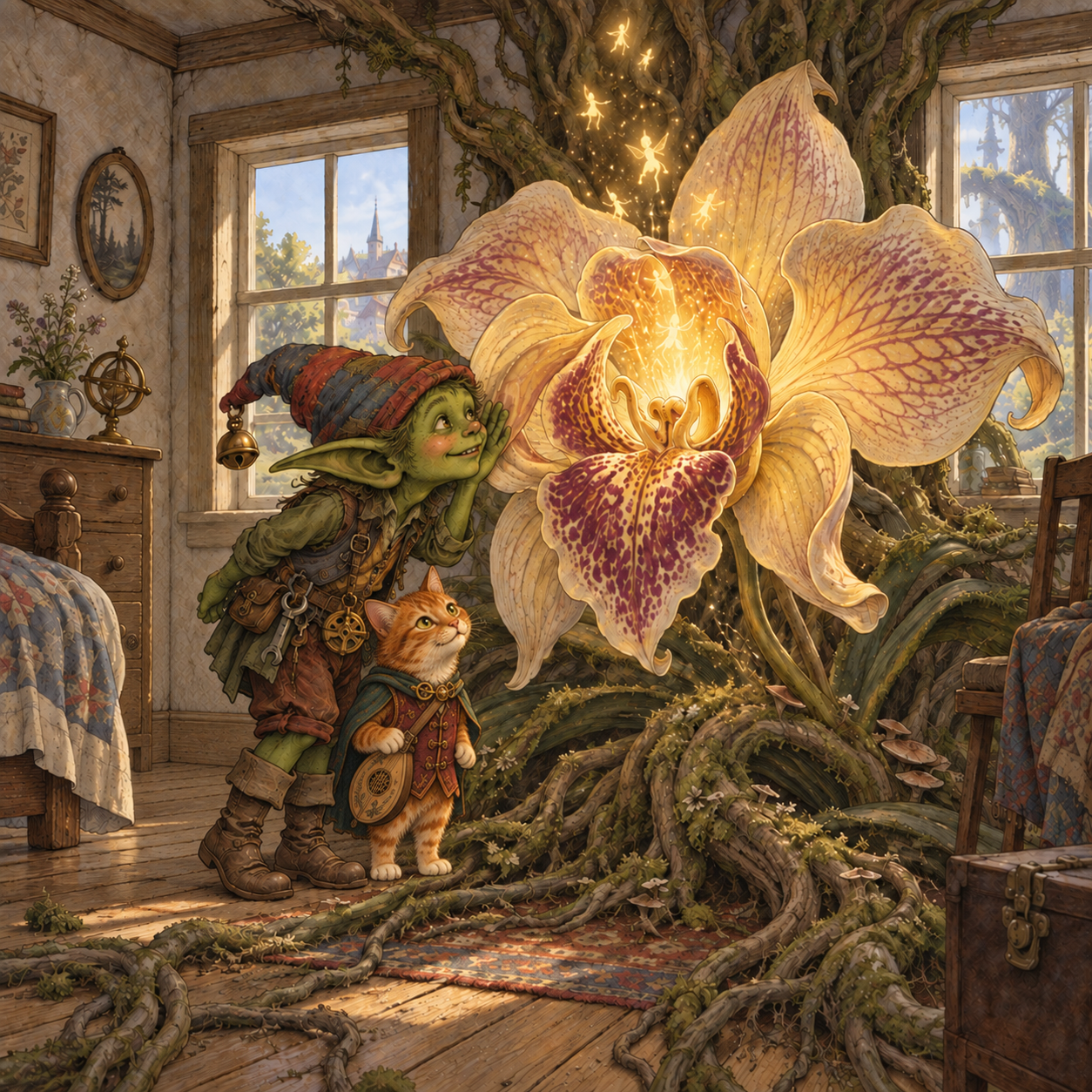
Four walls enclosed it. Windows admitted the ordinary daylight, some looking down into the greenhouse below. Yet within those boundaries lay what seemed to be a piece of ancient forest, brought indoors without any particular concern for whether it belonged there. Massive roots rose and twisted through the space. They suggested a tree of impossible size, although no such tree stood within the room. The air smelled of damp earth and old growth.
At its center bloomed an enormous flower, something like an orchid. Light moved within it. Tiny motes floated up from among the petals, hovering with an unhurried brilliance. Hat stepped closer, drawn by the sense that the room was listening to someplace very far away.
Then they heard a giggle. A whisper followed. Another small sound answered it, faint and casual, as though the flower had opened upon a conversation whose participants had no idea they were being overheard.
Fairies, going about their lives.
Waer’dara regarded the blossom. “Creepy.”
“This is great,” Hat said.
Bartholemeow peered into the drifting lights. “Hat, look at this. I may need to change my bet.”
Barnaby had the air of someone prepared to enjoy that admission.
“We need a third column,” Bartholemeow continued. “We’re going to find those fuckers.”
Thalmiir stood among the roots with the weight of the remaining gold at his side. They had begun the night by paying to keep an old obligation satisfied. Now they had spent a hundred more to give themselves offices, possibilities, and a flowering connection to somewhere they did not understand.
From within the orchid came another soft whisper. Then a voice rose from downstairs.
“Hello?”
They turned toward the door.
The session opened with a recap of the party’s arrangement with Mr. Sterling. Although Sterling appeared knowledgeable about the world’s arcane mysteries, he professed not to believe in them; he nevertheless considered the interest surrounding those mysteries an opportunity to make money. After their initial activities in Waterdeep, the adventurers had traveled to Secomber to profit from the boomtown developing around the search for the Urn of Chauntea. They had briefly pursued a campground venture before abandoning it and establishing a remarkably successful bakery. As the bakery began operating efficiently and earning money, the party became involved with Destiny and her business in addictive beauty products. Destiny had also stolen a flower from sprites, and Barnaby had joined the party’s efforts to recover it. The recap established that the adventurers had attended Destiny’s party, killed her, recovered the flower, and looted money and valuables. Her guards were dead, and her remaining staff had fled. Bhakris characterized the violence as self-defense. Play resumed shortly after the party had brought Dr. Nathaniel Merville outside to see the stars again. Thalmiir realized that the calendar had advanced to the first of Flamerule and that their payment to Sterling had been due at the end of the preceding month. Before the party went to bed, Thalmiir announced that they needed to make their payment and called for the available money to be assembled. The amount due was confirmed as 500 gp. Thalmiir reviewed the valuables he had recorded: 100 gp, a gold pen set worth approximately 100 gp, and 800 gp in coins and gems recovered from the strongbox in Destiny’s secret laboratory. He also listed a thesis and three vials of silvery liquid believed to be liquid confidence. His suggestion that the thesis was worth 1,000 gp and that the liquid was effectively priceless was not established as a confirmed sale value. Thalmiir initially proposed paying Sterling with the gold pen set and 400 gp in more readily spendable currency, preserving more of the party’s coins and gems. Barnaby wanted to check the pen set for magic before surrendering it. The party gathered in the upstairs lounge, where he spent ten minutes casting Detect Magic. The elevator registered as magical; the pen set did not. Barnaby questioned whether their contract permitted payment in goods rather than cash. The contract did not clearly specify this, and he worried that Sterling might treat the pen set as a gift while still demanding the remaining 100 gp. The discussion also raised the possibility of disputed appraisals. The DM clarified that gems were commonly used as currency and that their values were generally recognizable, whereas the value of a pen set or damaged jewelry could require negotiation. Hat remembered that he possessed melted jewelry worth 15 gp. It had been taken from Destiny’s incinerated corpse. During the discussion of its material value, Thalmiir identified it as solid gold. The party ultimately chose to pay the entire 500 gp in loose coins and gems. Thalmiir placed the agreed amount into their magical payment receptacle, which accepted it with its familiar otherworldly swallowing sound. He quickly withdrew his fingers. After recovering some of his composure, Nathaniel offered the adventurers beds in the downstairs staff break room. As the only staff member remaining, he felt able to invite them to stay and admitted that he would welcome the company. Bartholemeow accepted the offer and asked Nathaniel whether he would consider continued employment, adding that they would let him go outside. Nathaniel explained that he had no one outside the building and nowhere else to go. He suggested discussing the matter in the morning and believed they could reach an arrangement. Nathaniel had spent very little time on the ground floor and was not particularly familiar with it. He nevertheless closed and locked the front door before finding a bunk. The staff break room contained enough beds for everyone, arranged in bunks stacked three high. The accommodations were basic, but the party took a long rest. No one came to the building during the night seeking vengeance. In the morning, Hat was awakened by scratching sounds inside his Documancer’s satchel. He initially spoke to the closed satchel, then investigated the sound, which resembled a quill writing on paper. Inside, Hat found a letter from Sterling and saw the final flourish of its signature appearing. Sterling addressed the correspondence to the party’s Decisionist and colleagues; the group had not established that he knew the name “Thalmiir’s Thunder.” Sterling acknowledged that the party had now made two more-or-less timely payments. He expressed confidence that they were establishing themselves in Secomber and would develop into an economic powerhouse. Sterling’s letter announced further investment in the party’s borrowed infrastructure. The Documancer’s pouch now allowed two-way communication with him, and the other implements associated with their franchise offices had also gained new capabilities that he encouraged them to investigate. Sterling said that he intended to maintain the arm’s-length relationship described in their founding contract rather than manage their activities. He nevertheless requested a brief account of their progress since their last communication. He also reminded the party that he could help provide material resources, obtain information, or recruit personnel. He expected a prompt response. Hat learned that he could write correspondence and place it in the Documancer’s satchel to send it to Sterling. Without first consulting the others, he replied that everything was going well, that they thought they now owned a house, and that he would appreciate interesting magical things they could blow up. He said he would speak with Thalmiir in the morning. Sterling did not immediately answer. Hat briefly considered returning to sleep, then decided the discovery was exciting enough to wake Thalmiir, whom he regarded as being in charge. Hat considered waking Thalmiir with a magically produced bad smell but instead shook him awake. He showed him the letter, explained the new communication ability, and admitted that he had already asked Sterling for explosives. Thalmiir warned that Sterling would charge them for anything he sent. Hat thought Sterling sounded friendly and helpful, but Thalmiir emphasized that theirs was a business partnership. Hat said he had known about the satchel’s new ability for approximately five minutes. Thalmiir wanted the whole party to discuss their response and suggested that they might now need to present an actual business plan. Thalmiir initially told Hat not to write again until morning, partly because he did not want to disturb Sterling. Hat pointed out that Sterling had just written to them and was evidently awake. The time was clarified as approximately seven in the morning, after sunrise. Thalmiir then proposed a short reply explaining that the party was developing several opportunities, working on a business plan, and would request resources when necessary. Hat conveyed the broad substance of this message in his own less formal style. Because this conversation took place in the shared sleeping room and Hat made no attempt to be quiet, the others could hear it. Bartholemeow joined in over Hat’s shoulder and suggested inserting business language such as “synergize.” Bhakris focused on Sterling’s offer of supplies and requested full plate armor. Thalmiir again stressed that they would be buying it, while Bhakris described the armor as an investment. Thalmiir asked Bhakris to prepare a proposal demonstrating the return on an investment in full plate. Bhakris responded with a drawing of a paladin in splendid armor surrounded by dead enemies, presenting the image as self-explanatory evidence. Hat investigated the limits of the Documancer’s correspondence ability, asking whether the satchel could transmit any written material or whether it required his special writing supplies. The communication method was established as requiring the appropriate Documancer’s calligraphy supplies and someone qualified to use them, rather than simply accepting any ordinary document placed in the bag. To make his armor proposal easier to reproduce with the proper supplies, Bhakris worked on a relief carving of the armored paladin and fallen foes that could be traced onto paper. Hat also asked whether writing on a small object, such as a piece of wood, would allow him to send that object. The DM established that the correspondence had to be placed in the supplied envelopes and that the system was intended to transmit messages rather than goods. Unrelated contents placed in the satchel would remain there. Hat sent a request for full plate in addition to his earlier request for explosives. Taking Thalmiir’s warning into account, he specifically said that the party would appreciate free help obtaining the armor. Sterling answered shortly afterward. He observed that some people might consider purchasing such items locally more economical than shipping them from Waterdeep, but said he did not intend to question those to whom he had delegated authority. Sterling asked how urgently the party needed the explosives and armor. He explicitly warned that faster delivery would entail considerably higher costs and offered to add those costs to the party’s debt if they wished. Hat conceded that Thalmiir had been correct about Sterling charging them. Bhakris initially interpreted the response as referring only to shipping costs and continued considering a negotiation. The discussion turned to the original contract. Bartholemeow had read it carefully with the concerns of someone familiar with fey contracts and remembered that Sterling could provide services, decide their value himself, and add that amount to the party’s debt. Sterling could also increase the monthly payment at his discretion. Bartholemeow explained these terms to Hat and Bhakris. Hat called the arrangement a scam; Bartholemeow pointed out that they had all signed it. Following an Insight check, Bartholemeow recognized that Sterling’s language about “investing” in their success came directly from the contract and meant adding to their debt. Bartholemeow also speculated that even their correspondence might be generating further charges, though no specific charge for sending letters was confirmed. Thalmiir suggested using their existing income streams to purchase armor locally instead of accepting whatever price Sterling chose. The DM reminded Bhakris that he had recently befriended an armorer. Bhakris sighed and accepted the local-purchase approach. The party assembled a good breakfast from the supplies in the building’s commercial greenhouse café. While they were doing so, Nathaniel excused himself to retrieve some things from his upstairs office. The sprites Pandora and Olberic arrived through a partly open window. Olberic, who had previously surrendered his fairy magic so the party could receive magical trinkets, looked particularly worn down. Pandora was also in poor condition. The sprites explained that the fairy exclusion zone had gone down, returned, and then gone down again. They had found its renewed operation distressing and now wanted to know whether the party had recovered the flower. Barnaby confirmed that they had it. Pandora expressed her desire to kill Destiny herself, only to learn that Destiny was already dead. The sprites approved of her fate and returned their attention to the flower. Barnaby handed over the recovered flower. Before accepting it, the sprites performed an elaborate sequence of bows, advances, and a coordinated bow together. Olberic finally took the flower with great reverence. Bartholemeow then raised the matter of payment for recovering it. Olberic acknowledged that a reward had been discussed but began backing toward the window, explaining that he needed to get the flower home. He flew out with it. Pandora remained briefly with Barnaby despite clearly wanting to follow. She acknowledged that the party had done everything promised and more by recovering the flower and killing Destiny. She said they would forever be in the party’s debt and repeatedly promised to return and make good on the payment. Pandora offered to steal money from houses immediately if that was what the party wanted. When Hat asked about good houses to rob, she replied that houses generally contained money and demonstrated how easily she could enter them by turning invisible and then visible again. Pandora reiterated that she would return and followed Olberic out of the window. No reward was delivered during this exchange. Bartholemeow predicted that they would never see the sprites again. Barnaby maintained that pixies were reliable. Using the café’s menu chalkboard, Bartholemeow recorded two competing predictions: Barnaby’s expectation that the sprites would return and his own expectation that they would never be seen again. Waer’dara sided with Bartholemeow, while Hat said the sprites would come back. Thalmiir produced his ledger and began recording bets, including a 10 gp wager on the sprites not returning. Nathaniel returned from upstairs and approached Barnaby with a discovery concerning a theory he had previously been unable to test. He believed Destiny had somehow willed the upper floor into its previous arrangement. Nathaniel recalled that, early in the business’s development, he and Destiny would discuss needed facilities and then those facilities would simply be present. He now had evidence for his theory because much of the upstairs no longer existed as it had before. Barnaby went upstairs by elevator to investigate. The guest lounge, Destiny’s executive office, and the laboratory office where Nathaniel had first been encountered remained as the party remembered them. Nathaniel suggested that these rooms appeared to be anchored. Nathaniel cautiously opened one of the previously unexplored doors. He warned the party not to step through, though he thought looking was safe. Beyond the doorway lay a primordial nothingness instead of the expected corridor or room. Nathaniel hypothesized that someone with sufficient willpower could open a door and cause a desired space to appear beyond it. He suspected that the process might also require material components or some other expenditure, but did not understand the mechanism. Waer’dara suggested a fully stocked treasure vault. Bhakris held his armor drawing, concentrated on an otherwise empty room containing full plate, and opened a door from the lounge. Bartholemeow gave Bhakris Bardic Inspiration. It was clarified that the room-generation rolls were not tests that could be failed, so the inspiration did not apply to them; Bhakris retained it for an appropriate later use. The first room-generation rolls were 2, 4, and 18. The DM explained that the party would receive three possible rooms and select one. Higher rolls would prompt more unusual or powerful options, while lower rolls would produce more ordinary choices. The initial construction cost was established as one free room draft per tenday. Additional drafts during that period would normally cost 100 gp in matter or valuable materials that the building could transform into a room. Rooms could provide passive benefits simply by being included in the building. Their active abilities required downtime activities, with different results available at different difficulty levels. The first option was a Construction Office, a brown-category room with four doors. Its passive benefit reduced drafting costs by 50%. The Construction Office also enabled the party to replace existing rooms. Its active ability used Athletics or Intimidation: DC 10 allowed a replacement of the same color and layout, DC 15 allowed one with the same layout, and DC 20 allowed any layout. The party could also pay to reject a set of three room options and receive three new choices. Before discounts, successive rerolls cost 100 gp, then 200 gp, then 400 gp. The Construction Office’s 50% reduction applied to these costs as well. The second option was a Dormitory, with one door. Its passive benefit gave staff a +1 bonus to their rolls. Its active ability, catching a nap, used Stealth or Performance to grant +1, +2, or +3 to the next staff roll. Failure imposed a −1 penalty on the next staff roll. “Staff” meant hired help rather than the adventuring characters. Nathaniel was treated as their current staff member for this explanation, and employees brought over from Moonflower Bake Creations could also count. The third option was an Herbarium, a green-category room with four doors. Its passive benefit added 25 gp to the monthly business result, either increasing a profit or reducing a loss by that amount. Its active benefit could grant +1, +2, or +3 to other staff rolls during the downtime. Rooms could be rotated when placed. The selected room had to have a door matching the doorway through which it was being created, but the party did not have to align all its other doors with neighboring spaces. Bhakris favored the Construction Office, and Thalmiir, Barnaby, and Hat supported the choice because its discount would be useful while expanding the building. Bartholemeow expressed interest in the Herbarium, but the party chose the Construction Office. It was confirmed as the option associated with the roll of 18. Bhakris felt a strange pressure in his mind as his initial vision of armor gave way to the three available possibilities. Once he settled on the Construction Office, the space beyond the door grew almost organically into the chosen room. The completed office contained drafting tools, hammers, barrels of nails, and other construction supplies. A punch list had one entry—“Construction Office”—already crossed off. Bhakris did not receive the armor he had envisioned. However, the room contained a barrel of metal ties for fastening beams together, branded “Full Plate.” He remained hopeful that the office might eventually help them obtain an armory. Thalmiir asked Nathaniel whether Destiny had written anything about the building’s powers. Nathaniel said she had never shared such information with him, but her office remained available to search. With no immediate pressure, the party could search the office thoroughly. Among older paperwork, they found notes documenting Destiny’s development of the room-creation technique. Destiny’s notes indicated that creating new spaces depleted some form of local magical energy. Throwing valuable materials into the void could replenish that energy to some extent. Destiny did not directly record her failures, but the notes implied that she had needed considerable time to learn how to obtain the spaces she wanted. Thalmiir particularly sought information about dangers and drawbacks. One explicit warning in Destiny’s notes read, “Pay attention to where the doors are.” He spent the morning reviewing the material and sharing his findings with the party. With the Construction Office in place, another room would cost 50 gp. Thalmiir asked whether they could inspect a new set of options and then cancel without selecting anything. The DM clarified that initiating a draft required a choice; they could pay to reroll the options but could not simply walk away. Bhakris recalled feeling compelled to choose, and the possibility was raised that the building might choose for itself if they did not. The available upper-floor layout was defined as a grid five spaces wide and three spaces tall. Thalmiir asked whether creating rooms required particular building materials or whether coins and jewelry would suffice. The process was described as an exchange based on value: objects of sufficient value could be thrown into the void without obtaining specific supplies. It remained uncertain how the building would value an object of great personal significance but little ordinary monetary worth. The party also had no assurance that sacrificing an item worth more than the required amount would return any change. Thalmiir decided to spend 50 gp to try another room. The party chose a doorway intended to help connect their layout around an otherwise empty corner. The second set of rolls was 14, 5, and 8. The resulting options were a Staff Lounge, a Production Lab, and an Ad Agency. The Ad Agency was a gold-category room. Its passive bonus applied to relevant franchise activities, such as sowing rumors, schmoozing, or conducting an advertising campaign. The Ad Agency’s active benefit applied to the next franchise roll more broadly. Its three levels of reward were advantage, advantage with a +2 bonus, or advantage with a +5 bonus. The DM clarified that active room abilities were downtime options. Player characters could choose downtime actions, and staff could also be assigned actions. With one staff member, the party currently had one such staff assignment available; the exact options for a fully staffed Tier 2 franchise were left for later clarification. The Production Lab offered potion-making as a downtime activity, with production possible within a week. The DM reconsidered the listed costs and halved them, announcing costs of 12, 50, and 100 gp for the three tiers. The potion-making options corresponded to DC 10, DC 15, and DC 20. Known recipes included a common healing potion, an uncommon greater healing potion, and a rare vial of Nathaniel’s liquid confidence. Bartholemeow considered selling discounted potions to the adventurers in town. Barnaby pointed out that the lab’s output was limited to one potion per downtime use, restricting the immediate scale of that business. Hat asked whether employing a potion specialist could support continued production. Nathaniel was identified as an accomplished potion maker who had already expressed interest in working with the party. Bartholemeow suggested that liquid confidence might sell for 1,000 gp a vial and mentioned two competing adventuring groups as possible customers. The discussion acknowledged that such a sale would require finding a buyer; no sale or confirmed market price was established. The party weighed the Production Lab against the Ad Agency. Bartholemeow preferred the advertising option, and Barnaby also favored it, particularly because of its door arrangement. Thalmiir was willing to accept either and ultimately supported the Ad Agency. The party selected and placed the Ad Agency, orienting it to suit their planned layout. Thalmiir explained that they now had several business opportunities and needed to get the word out. He had become absorbed in the possibilities of a magical house in which they could create rooms. Barnaby took the building’s responsiveness as evidence that it was now their house. When Thalmiir hesitated over spending more money, Barnaby argued that the Construction Office allowed them to obtain two additional rooms for the 100 gp they would otherwise have paid for one. The party agreed to fund another room at the discounted 50 gp cost. During the exchange about the bargain, Bartholemeow felt the Ad Agency resonate around him. The next doorway was chosen to fill the empty corner. The third set of choices consisted of an R&D Lab, a Conduit to the Primal Woods, and a Seed Vault. The Conduit to the Primal Woods offered an active ability called Seek an Audience. It had no DC 10 result: DC 15 allowed the party to obtain a quest, and DC 20 allowed them to request a boon. Persuasion and Nature were established as the relevant skills for the Conduit’s active ability. The room suggested some means of communicating with great forests beyond civilization and interacting with forest fairies, though the exact nature of that contact remained mysterious. Bartholemeow favored the Conduit because his Persuasion checks had a very high minimum result. The R&D Lab’s active ability could permanently increase business revenue by developing new products to stock in the shop. Successful uses would stack, while failure risked a temporary reduction in revenue. The DM noted that limits might be needed later if the accumulated increases became excessive. The Seed Vault offered a DC 20 activity to discover a new useful plant. The specific benefits of such a discovery were not yet defined, though useful plants might support other capabilities of the house. Thalmiir initially leaned toward the R&D Lab, and Barnaby also showed interest. The party discussed their access to alchemical expertise and Nathaniel’s possible usefulness in research, but did not assign him a research task. The discussion shifted toward the Conduit because several members of the party had fey connections and they had just completed a task for the sprites. Thalmiir changed his preference to the Conduit, and the others agreed. The party selected the Conduit to the Primal Woods and placed it in the corner. Its doorway fit the planned arrangement, though it did not provide additional exits for further expansion. The newly formed room still had four walls and windows, including windows overlooking the greenhouse below, but otherwise resembled a piece of ancient forest. Massive roots appeared within the room as though connected to a giant tree. At the center stood a large, orchid-like flower, with magical motes of light hovering around it and emerging from within. Occasional fairy giggles and whispers seemed to come from the flower itself, suggesting fairies going about their lives somewhere beyond the room. Bartholemeow called Hat over to look and reconsidered the earlier wager. He proposed a third possibility beyond the sprites returning or never being seen again: the party could go and find them. A voice then called “Hello?” from downstairs. The identity of the caller was left unresolved as the session’s in-game action ended. In the final clarification of the room rules, Bartholemeow stated that his Persuasion checks had a minimum result of 20, making him well suited to attempting the Conduit’s highest listed difficulty. The DM explained that the intended difficulty tier must be declared before using a room’s active ability. A character attempting a DC 10 option receives only that option’s benefit even if the result reaches 20; a higher roll does not automatically substitute a different tier’s reward. The party also clarified that the three original, anchored rooms had their own benefits. When asked whether they could be replaced, the DM allowed that the Construction Office could make this possible, while warning that these were the only existing rooms providing access downstairs. A feature called Dragon Contentment was discussed in connection with the executive area and its balcony. It had no established mechanical effect, but the balcony was described as a place where the dragon could preen before admirers below. The original upstairs lounge was finally clarified to be the Guest Lounge, distinct from the unselected Staff Lounge. Its stated benefit was access rather than an additional special mechanical bonus.Session Notes